
استمع إلى القصيدة
سَلَامٌ عَلَى أَبْهَا وَمَنْ حَلَّ فِي أَبْهَاكَسَتْهَا مُزُونُ الْغَيْمِ بِالْحُلَّةِ الْأَبْهَى
تُقَبِّلُ خَدَّيْهَا الْغُيُومُ بِرَشِّهَافَيَحْمَرُّ خَدَّاهَا لِتَبْدُو لَنَا أَشْهَى
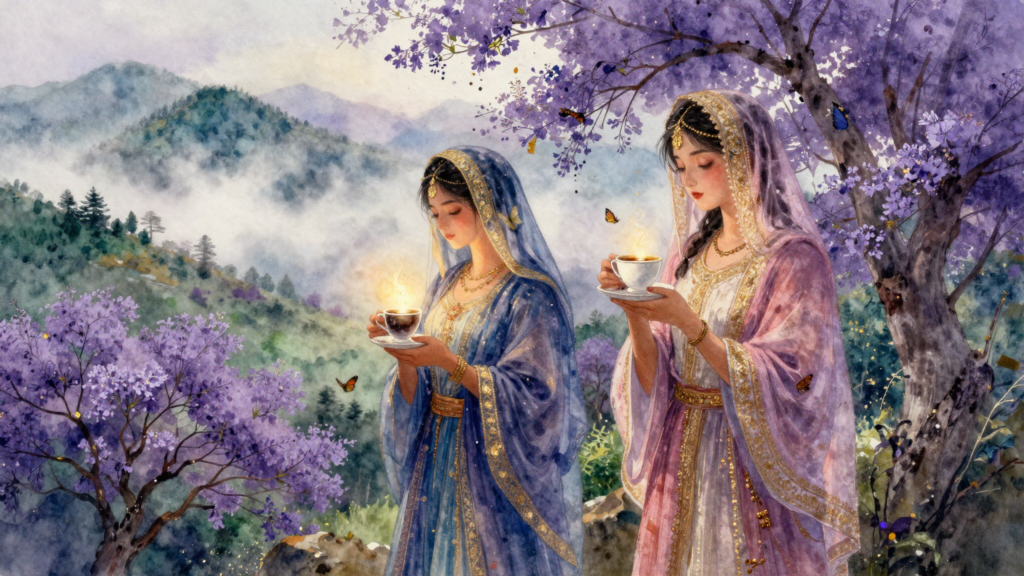
إِذَا وَشَّحَتْهَا الْجَاكَرَنْدَا بَنَفْسَجًابَدَتْ غَادَةً تَزْهُو بِأَلْوَانِهَا الْأَزْهَى
وَأَزْهَارُهَا وُرْقٌ عَلَى الْغُصْنِ غَرَّدَتْجَوَايَ فَلَحْنِي فِي هُيَامِي صَدىً مِنْهَا
وَلِي فِي رُبَاهَا ظَبْيَةٌ مِنْ بَهَائِهَااسْتَعَارَتْ مَغَانِيهَا وَأَلْطَافَهَا أَبْهَا
أَحِنُّ إِلَيْهَا كُلَّمَا غَيْمَةٌ هَمَتْوَحَامَتْ فَرَاشَاتٌ يَلَذُّ لَهَا الْمَلْهَى
بِنُورِ مُحَيَّاهَا صَبَبْتُكِ قَهْوَتِيوَمَا سَكْرَتِي إِلَّا عَلَى ذَلِكَ الْمَقْهَى
وَأَنْسَتْنِيَ الدُّنْيَا وَكُلَّ نَعِيمِهَاسِوَاهَا، وَسُكْرُ الْحُبِّ عَنْ غَيْرِهَا أَسْهَى
Peace upon Abha
- Peace upon Abha, and on all who dwell in Abha!
The rain-clouds have robed her in the most resplendent attire1. - The clouds kiss both her cheeks with their spray, and her cheeks flush red,
so that she seems to us all the more to be desired. - When the jacaranda drapes her in a sash of violet2,
she seems a young beauty, preening in her brightest colours. - Her blossoms are doves3 on the bough that have warbled my ardour,
and my melody, in my love-madness, is only an echo of their choir. - And on her hills I have a gazelle, from whose splendour4
Abha has borrowed its lovely haunts and all its graces. - I yearn for her whenever a cloud pours down its rain
and butterflies hover, at play to their hearts’ desire. - By the light of her face I poured you my coffee5,
and nowhere but in that café do I grow drunk. - She has made me forget the world and all its bliss, all but her;
and nothing turns the mind from all but her like the drunkenness of love.
Notes
- Abha, the city in the ʿAsīr mountains of south-western Saudi Arabia, famous for its rains and mists, has a name identical in sound to abhā, ‘most resplendent’. The verse opens with the city’s name and closes on the adjective, al-ḥulla al-abhā, ‘the most resplendent robe’, so that the robe woven by the rain is itself ‘Abha’. ↩
- Jacaranda trees, with their violet-blue blossoms, line many of Abha’s streets. Washshaḥathā means ‘girded her with a wishāḥ’, the jewelled sash worn by women across the shoulder and waist. ↩
- Wurq means grey doves, whose cooing is a classic voice of longing in Arabic poetry; written without vowels it is identical to waraq, ‘leaves’. The blossoms on the bough are thus both leaves and doves, and it is as doves that they ‘warble’ the poet’s passion, which he then only echoes. ↩
- The comparison is reversed for hyperbole: instead of the woman being beautiful like the city, the city is said to have borrowed its beauty from her. Bahāʾ, ‘splendour’, is the root of abhā, ‘most resplendent’, which the city’s name echoes. Maghānī are dwelling places, especially the pleasant haunts remembered in love poetry. ↩
- In classical Arabic qahwa was a name for wine, long before it came to mean coffee; hence the poet can speak of drunkenness in a café. What intoxicates him is not the drink but the light of her face under which it is poured. Ṣababtuka qahwatī is taken as ‘I poured you my coffee’, the ‘you’ being the listener or companion; it can also be read as addressed to the coffee itself: ‘I poured you, my coffee’. ↩
English translation prepared by artificial intelligence and reviewed against the Arabic for accuracy of meaning and rhetoric.