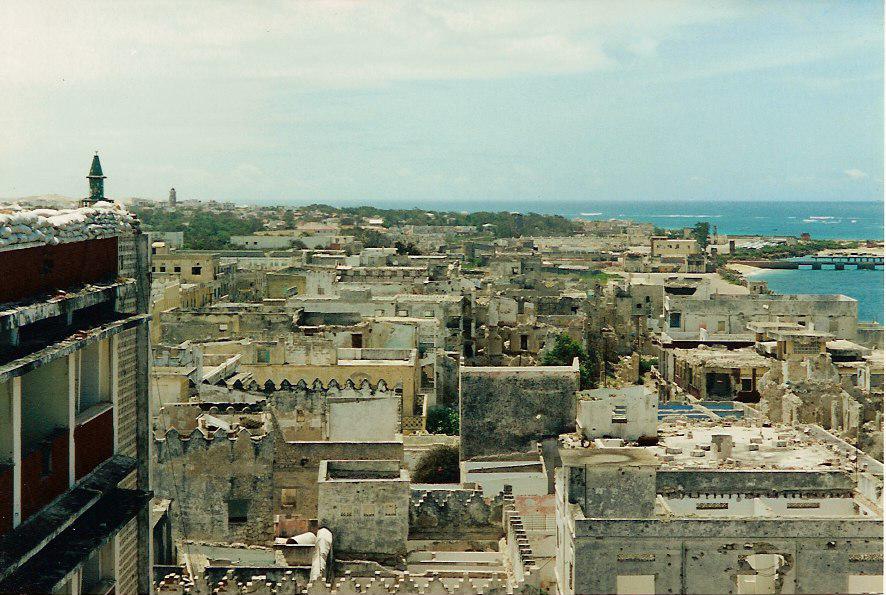
الصورة: مبانٍ مدمّرة على ساحل مقديشو، يوليو 2007 — ctsnow، ويكيميديا كومنز (CC BY 2.0) — صفحة الصورة
قُدّمت هذه الورقة في ندوة «التدخلات الأجنبية ومستقبل القرن الأفريقي» التي عُقدت في الدوحة بدولة قطر يومي 7 و8 يونيو 2007، تحت رعاية المركز العربي للدراسات والبحوث والحملة العالمية لمواجهة العدوان. وكُتبت في لندن بتاريخ 29 مايو 2007.
ملخص الورقة
تسعى هذه الورقة إلى اجتراح حل للمشكلة الصومالية التي تفاقم وضعها منذ الاحتلال الإثيوبي للصومال. وترسم خطة متكاملة لمواجهة الاحتلال عبر جهود أبنائه ومساعدة ودعم إخوانه. وتستعرض قبل ذلك الوضع الحالي ومواقف الصوماليين منه ثم الأطراف الفاعلة على الساحة ومواقفها المختلفة سعيا إلى استكشافه والتعامل معه كي يتسنى معرفة الأرض والواقع التي تسير فيها الأحداث لكي يتم التعامل معها بعد التعرف عليها.
ثم تستعرض الحلول التي يجري تداولها بين بعض النخب الصومالية وصولا إلى الخروج من الأزمة. وأخيرا تجترح حلا تدعي أنه متكامل بوضع استراتيجية بعيدة المدى توسع أفق الأمل وساحة العمل وصولا إلى إخراج المحتل وبناء الصومال من جديد على أسس وحدوية وطنية وقومية.
مقدمة
لا شك بأن الأزمة الصومالية التي جاوزت سن الرشد تحتاج إلى حل، ولكن الحل ينبغي أن لا يكون مبتسرا غير متكامل فمثل هذه الحلول أشبه بالعلاج الخارجي لخراج يتقيح من الداخل. فما لم يستخدم الطبيب مبضعه لاستخراج الخراج وتنظيفه من القيح والصديد لن يجدي المرهم الذي يدهن به من الخارج. كذلك يجب أن لا يكون الحل متعسرا أي غير ممكن التطبيق أو الإدراك، وإن كان سيأخذ وقتا طويلا فينبغي تطبيقه على مراحل للوصول إلى الغاية المنشودة. وفي مثل الحالة الصومالية فإنه ينبغي أن تحل العقد المتراكمة عقدة بعد عقدة حتى يستقيم الحبل ويمكن الإمساك به. ولاجتراح مثل هذا الحل فإنه لا بد من تشخيصه أولا ثم استعراض الحلول الممكنة وموازنة السلبيات والإيجابيات والعوائق والفرص فيما بينها لاختيار أخفها ضررا وأكثرها قبولا للتطبيق.
تشخيص الوضع الحالي
لا بد للتشخيص أن يصل إلى توصيف للمشكلة عن قرب ويشير إلى العوامل التي تؤزمها ويحدد أطرافها ودور كل طرف فيها، حتى يتسنى إيجاد أفضل طريقة للتعامل معه.
اختلاف في الرؤى
ينظر الكثير من الصوماليين إلى المشكلة الصومالية بوضعها الحالي بنظرة مختلفة عن الآخر بحسب قربه أو بعده، وارتباطه المصلحي أو المبدئي من هذا الطرف أو ذاك. وإذا أردنا أن نشخص المشكلة فلا بد من التعرف على وجهات النظر هذه كلها ونأخذها بعين الاعتبار عندما ندخل في صياغة حل لها.
الفريق الأول
يرى أن الوضع الحالي وضع لا يمكن أن يسمى احتلالا بالمطلق. بل استعانة حكومة ذات سيادة بحكومة أخرى لتعينها على إقرار الأمن ومواجهة أطراف مسلحة لا يمكنها مواجهتها. وعليه فإن الطريق إلى الخروج من الأزمة هو التعاون مع هذه الحكومة الانتقالية ومساعدتها في استعادة الأمن. وهذا الفريق أيضا ينقسم إلى قسمين:
- قسم لا يتردد في القبول بأن وضع الصومال وضعية بلد محتل. ولكنه يرى أن القتال المسلح معه غير ذي جدوى بالنظر إلى قوة عتاده وعدده والتواطؤ الدولي معه. لذا فإن أفضل الطرق إلى إخراج هذا الاحتلال هو بتقوية مؤسسة الحكومة والعمل معها إلى حين انتهاء مهلتها المتبقي منها عامان وبعدها يمكن عن طريق تقوية دور المجتمع المدني وإنشاء الأحزاب مع وجود المحتل أن تنتهي الشخوص التي يعتمد عليها الاحتلال ثم يطالب من خلال المؤسسات بخروج القوات الإثيوبية.
- أما القسم الثاني فيرى أن الوجود الإثيوبي ليس احتلالا وأنه جاء من خلال دعوة الحكومة الشرعية لحمايتها ومحاربة المتمردين الخارجين عن الشرعية بدلا عنها. وعليه فإن محاربة أو مقاومة القوات الإثيوبية هو رفض للحكومة متدثرا برفض الاحتلال. والذين يقومون بهذا لا يقومون به من منطلق ديني بل قبلي يريدون أن يبقوا ما تم لهم خلال الحرب الأهلية، وما الدين سوى واجهة يريدون بها خداع الشعب ليقاتل إلى جانبهم.
الفريق الثاني
يرى هذا الفريق البلد محتلا من قبل القوات الإثيوبية وأن الحكومة الانتقالية ما هي إلا أداة تعمل لهذا الاحتلال وتكريسه ما دام يخدم مصالح الفريق المتعامل معها الشخصية، بغض النظر عن مصلحة الشعب. وعليه فيرى هذا الفريق أنه ينبغي العمل على إخراج هذا المحتل وعدم تضييع الوقت في الكلام، بل مجابهته بالقوة والمقاومة حتى يخرج عن البلاد. وهؤلاء ينقسمون إلى قسمين:
- قسم وصل إلى هذا الاستنتاج بسبب المبدأ أو الأيديولوجيا التي يعتنقها سواء كان منطلقها دينيا أو وطنيا. وهذا القسم موقفه أصلب المواقف ولا يمكن أن يتغير. وهو يستحضر زخم الصراع التاريخي بين الصومال وإثيوبيا والأطماع الإثيوبية في الأراضي الصومالية، ويستند إلى حقائق التاريخ والجغرافيا والسياسة، ثم يستشهد بالدور الإثيوبي المدمر خلال الحرب الأهلية.
- والقسم الآخر وصل إلى هذا القرار بسبب خسارة الطرف الذي يمثله سواء كان هذا الطرف قبيلة أو شخصا أو منطقة. أو ضياع مصلحة قبيلته بسبب الوضع الحالي. وهذا القسم يمكن أن يغير اتجاهه 180 درجة إذا وجد مصلحته مع الاحتلال أو الحكومة الانتقالية. فهو تبع للمصلحة وليس للمبدأ.
الأطراف الفاعلة على الساحة
الحكومة الصومالية
بات من الواضح لدى معظم الصوماليين أن الحكومة الاتحادية الانتقالية لم تأت لخدمة الوطن بل إنها مكونة من مجموعة أمراء الحرب الذين لا تربطهم علاقة تجانس. وهي لا تملك شيئا من أمرها في أغلب الأحيان بعد أن استخدمت كقميص عثمان لاحتلال البلاد. وتستخدم حتى هذه اللحظة من قبل الحكومة الإثيوبية كواجهة لتبرير احتلالها ولشرعنته.
ويجتاح بنيانها ضعف سياسي وبنيوي واقتصادي وعسكري.
ويتمثل الضعف السياسي في أنها لا تملك أي برنامج سياسي أو هيكل إداري. حتى المناصب الموجودة هي أسماء بلا مسميات فلا مقرات للوزارات ولا خطة عمل لأي وزارة. ولا تتحكم في أية مدينة حتى تلك التي تعلن سيطرتها عليها مثل مقديشو وبيدوة. أضف إلى ذلك عدم الكفاءة السياسية التي تؤهلها لانتشال بلد من دمار ألحقوه به طيلة سبعة عشر عاما.
أما الضعف البنيوي فإن العلاقة فيما بين أعضائها غير مترابطة ولا منسجمة، بل هي علاقة تباين في المصالح وتنافس في تقديم الولاء والخدمات لإثيوبيا حتى يتقرب إليها أكثر.
ويبدو الضعف العسكري ملحوظا من استعانتها بالأجنبي حيث لا تملك جيشا ولا شرطة بمعنى الكلمة بل تعتمد على مليشيات قبلية وقوات احتلال.
أما الضعف الاقتصادي فيتجلى في افتقارها إلى الموارد المالية اللازمة لتسيير شؤون البلد. وذلك بسبب تراجع أكثر الدول المانحة من منحها مساعدات مالية نظرا للضعف الذي تعانيه وعدم شعبيتها وخشية أن تجد طريقها إلى حسابات شخصية. وبينما استطاعت المحاكم الإسلامية تسيير دفة البلاد من جميع النواحي رغم عدم وجود أي موارد مالية من الداخل أو دعم من الخارج، يبدو السؤال المطروح لماذا يحتاج هؤلاء إلى الموارد المالية للقيام بأقل مما قامت به المحاكم رغم الدعم الدولي والشرعية القانونية التي تحظى بها حكومتهم؟
ويرجع ذلك إلى عدم شعبيتها ومعارضة معظم الصوماليين لها وإيمانهم بأنها مجموعة من اللصوص “جندوا من قبل قوى أجنبية، في بلد أجنبي لخدمة المصالح الأجنبية” وقد لخصت وكيل الخارجية الإيطالية سينتينيلي انطباعها عن الحكومة بعد أن قامت بزيارة لمقديشو والتقت بشخصياتها الرئيسية بقولها: “أعتقد أن الحكومة الانتقالية لا يمكن أن تؤدي مهامها بسبب افتقارها الى الدعم المحلي والمجموعات السياسية المختلفة في البلاد لا تشعر بانها ممثلة في الحكومة”
القوات الإثيوبية
قوات الاحتلال الإثيوبية هي الحاكمة الفعلية على الأرض. فهي التي تقاتل وتدمر وتفاوض وتهادن، ليس باسم الحكومة بل باسمها.
وتجلى وجهها الاستعماري عندما استخدمت الضربات الجوية والمدفعية الثقيلة عشوائيا في المناطق المكتظة بالسكان داخل مقديشو، وقام جنودها باغتصاب النساء، وتعمدت عرقلة وصول الغذاء والإمدادات الإنسانية رغم الحاجة الملحة إليها، وقصفت المستشفيات. مما نتج عنه تشريد أكثر من 500،000 من سكان مقديشو ومقتل 1600 من المدنيين. مما جعل الوضع في مقديشو أخطر بحسب مفوض الأمم المتحدة السامي لشؤون اللاجئين، وأكثر سوءا من أية منطقة صراع أخرى، إذ تسببت في تدفق أكبر عدد للاجئين من أي بلد آخر، بما في ذلك الصراعات في السودان والعراق.
وواضح أن قوة الاحتلال المدمرة تتعمد إضعاف الحكومة وتأكيد سيطرتها على الأرض وأنها صاحبة القرار الأول والأخير فلا يهمها أن تكون هناك حكومة صومالية أو لا تكون. والوضع معها في الصومال أشبه بالإقليم الذي تحتله منذ سنين (إقليم الصومال الغربي) حيث هناك إدارات معينة من قبل الاحتلال من أبناء البلد ولكنها لا تتحكم في شيء. بل تعتمد على القوات العسكرية الإثيوبية في قمع الشعب. ويخدم هذا المشهد السياسي الذي سعت القوات الإثيوبية إلى تكريسه أهداف إثيوبيا تماما في سعيها – كقوة استعمارية – لإبرام صفقات مباشرة مع القبائل في غياب أي مظهر من مظاهر السلطة.
المقاومة والمحاكم الإسلامية
المقاومة العسكرية قدمت نماذج للبطولة العسكرية والفداء للوطن، وأبلت بلاءً حسنا في التصدي للاستعمار الإثيوبي رغم إمكانياتها العسكرية المحدودة وافتقارها إلى الدعم الخارجي. وقد تجلى ذلك في حرب الأيام الثلاثة في مارس وحرب الأسبوع الواحد في أبريل والتي استخدم فيها العدو جميع إمكاناته العسكرية ولكنها عجزت عن كسر شوكة المقاومة الوطنية بله القضاء عليها. وكان قرار المقاومة تغيير التكتيك العسكري بما يقلل من الخسائر المدنية قرارا حكيما وصائبا، حيث حولت المقاومة تكتيكها من المواجهة المباشرة مستخدمة الأسلحة الثقيلة إلى حرب العصابات التي تنزل ضربات موجعة ومدمرة بشكل يومي على جيش الاحتلال وتحرمه من أي ميزة حتى هذه اللحظة.
لكن هذه المقاومة الباسلة تفتقر إلى أمور ربما تمثل نقاط الضعف فيها وهي:
- أولا: اندماجها مع مليشيات قبائل الجنوب “الهوية” التي كانت تقاتل تحت إمرة زعماء القبيلة ويفاوضون عنها ويهادنون باسمها. ولا يجري ذكر للمحاكم الإسلامية في المفاوضات، وهذا يضعف الخطاب السياسي للمحاكم ويصورها وكأنها حركة قبلية، ويجعل الكثير من الصوماليين يتخوفون منها. ومن جانب آخر يقوي الصورة التي تريد قوات الاحتلال إبرازها لدى الرأي العام الدولي من أن الصوماليين لا يرفضونها وإنما الذي يرفضها ويقاتل ضدها مجموعة قبلية كما يقوي زعمها أن الصومال ليست دولة إنما هي مجموعة قبائل بدوية متعارضة وغير متجانسة المصالح.
- ثانيا: وجود طرف محسوب على المقاومة لا يعمل تحت إمرتها ولا إمرة المحاكم ويعمل لأجندة خارجية وليست تحت سيطرة المحاكم. ويتكون هذا الطرف من المجموعة المسماة بــ “الشباب” وهي ذات توجهات متطرفة تقوم باغتيال الشخصيات والعمليات الانتحارية، وتستغل ظروف الصومال لخدمة أجندتها. وإذا لم يتم كبح جماحها أو التبرؤ منها والتعامل معها بحكمة فإنها قد تكبر وتتفاقم مشكلتها وتستعصي على الحل، وتصبح شوكة أخرى يمكن أن يستهدف الصومال بسببها. فينبغي عدم التستر عليها بل لفظها والعمل على عزلها من العمل المقاوم إلا إذا التزمت بمنهج المقاومة الحقيقي.
- ثالثا: ضعف الجانب السياسي للمحاكم من حيث البنية الهيكلية والتسلسل الإداري وافتقارها إلى المشروع السياسي المكتوب يضعف من إمكانيات تسويق انتصاراتها على الأرض والتفاوض عليها سياسيا.
زعماء القبائل ومليشياتها
زعماء القبائل في مقديشو اكتسبوا بعد دخول القوات الإثيوبية ثقلا سياسيا لم يتمتعوا به خلال فترة الحرب الأهلية حيث كان يسيطر أمراء الحرب ويهمشون دورهم إلا حين يستخدمون القبيلة لأغراضهم السياسية الدنيئة.
وقد استخدم هؤلاء الزعماء ثقلهم هذا في مواجهة الاستعمار بعد أن اكتشفوا أن الحكومة التي جاء بها الاستعمار تسعى إلى تهميش دور قبائلهم في الحكومة. فوقفوا مع المقاومة بسبب ذلك أولا ثم بسبب رفض الاحتلال. وفي حرب مقديشو الأخيرة برز اسمهم بشكل ملفت وتفاوضوا وتحدثوا باسم المقاومة في مقديشو وأداروا المعركة السياسية بجدارة.
وموقف هؤلاء الزعماء من الاستعمار الإثيوبي وإن كان حتى الآن جيدا – لا غبار عليه عموما – بسبب وعي البعض منهم ثم بسبب ضغط يأتيهم من قبل جل المثقفين من أبنائهم في المهاجر أو في الداخل حيث تصدر منهم بيانات متوالية تحث على مواجهة الاحتلال وعدم الخضوع له، إضافة إلى ما يشعرون به من ظلم لقبيلتهم. إلا أن هذا الموقف لا يمكن الركون إليه بشكل تام إذ قد تتغير الأمور إذا تغيرت الظروف.
أما موقفهم من الحكومة ورفضهم ومواجهتهم لها فهو موقف تمليه عليهم الطريقة التي تعمل بها الحكومة وتعاملهم بها من تهميش لدورهم.
ولهؤلاء الزعماء قدرة على ترجيح كفة طرف على أخرى ولكن ليس بإمكانهم إيقاف المقاومة التي لا تنتمي إلى قبيلة والتي تخوض حرب العصابات. بل جل ما يستطيعون منعهم هي المليشيات التابعة لهم.
البرلمانيون الأحرار
البرلمانيون الأحرار هم أعضاء البرلمان الذين رفضوا العمل مع الحكومة بعد أن استقدمت القوات الإثيوبية بطريقة غير شرعية وبدون استشارة البرلمان وعلى رأسهم رئيس البرلمان المنتخب قبل الحكومة والذي يحظى بشرعية دستورية. ويصل عددهم إلى الأربعين عضوا من مختلف القبائل والتوجهات ولكن معظمهم يتصفون بالوعي السياسي وبمستوى من الثقافة وشعور بالولاء للوطن.
وقد وقفوا موقفا مشرفا من الاحتلال والحكومة الاتحادية التي استقدمتهم ويعلنون عدم شرعيتها ليل نهار ويعملون على إسقاط مشروعها بالنضال السياسي.
ولكن هناك عدد منهم التحق بهم لحسابات أخرى غير المواقف المبدئية. وصلابة موقف هؤلاء محل تساؤل إذا ما عرضت لهم أطماعهم.
صوماليو المهجر
للصوماليين وجود كبير في المهجر شرقا وغربا بسبب طول فترة الحرب الأهلية. وقد كون معظمهم نفسه وكيفها على وضعية البلد الذي هو فيه، ولكنهم لا ينسون وطنهم. ولبعضهم ثقل سياسي أو أكاديمي في الحقل الذي يعمل فيه كما أن الأيدي العاملة منهم كثيرة ولهم تنظيماتهم وجمعياتهم أو مؤسساتهم الأهلية والمدنية الخاصة التي اكتسبت ثقلا في أماكن تواجدهم. ويمكنهم إذا نظموا أنفسهم أكثر التأثير على صانع القرار السياسي ولا سيما في الدول الديمقراطية.
وقد لعبوا دورا بارزا في وقوفهم مع المحاكم الإسلامية وما زالوا يلعبون نفس الدور في دعمهم للمقاومة ماديا. ويقومون بتحركات سياسية عبر مجموعات الضغط السياسي أو بصفة مباشرة عبر المؤسسات التي يملكونها في البلاد التي يتواجدون فيها، ولكن لم يصلوا إلى درجة تغيير السياسات بعد.
وفي هذا السياق أقيمت حلقات نقاش طويلة بين الناشطين السياسيين في الغرب لمناقشة أفضل الطرق لإخراج الاحتلال في كل بلد ثم اجتمع الناشطون في استوكهولم عاصمة السويد في 3-4 فبراير 2007 اجتمع فيه عدد يصل إلى الخمسين من قيادات التنظيمات ومن بعض الناشطين والمثقفين من دول أوروبية وأمريكا الشمالية، وأصدروا بعدها بيان استنكار لما يحدث في الصومال وشكلت لجنة في ذلك اللقاء مهمتها التنسيق والتحضير لمؤتمر أكبر يعقد في بريطانيا.
ونتيجة لذلك عقد مؤتمر أكبر في ليستر ما بين 6-8 من أبريل 2007 اجتمع فيه ما يقارب الـ 300 شخص من مختلف التوجهات والقبائل يمثلون نخبة المجتمع الصومالي في المهجر بمن فيهم المفكرون والمثقفون وأساتذة الجامعات وكذلك السياسيون والناشطون في المجتمع المدني. وقد شارك في المؤتمر أيضا أعضاء من المحاكم الإسلامية وأعضاء من البرلمانيين الأحرار.
وبعد مشاورات مكثفة جرت في أروقة المؤتمر بشكل شفاف بين جميع المشاركين من مختلف المنظمات السياسية الصومالية بما فيهم أعضاء البرلمانيين الأحرار وقيادة المحاكم الإسلامية، تم التوصل إلى توافق في الآراء لإقامة جبهة وطنية ذات قاعدة عريضة، تتولى مهمة تحرير البلد. وفي هذا المؤتمر تم الاتفاق على الوسائل والطرق المتفق عليها لإنجاز ذلك، واعتمدت خطة عمل طموحة، كما شكلت لجنة من مختلف البلدان لمتابعة الوضع في الصومال وكذلك للتحضير لمؤتمر أكبر بعد ستة أشهر.
وينظم هؤلاء المغتربون وغيرهم في مختلف العواصم الغربية مظاهرات لرفض الاحتلال والمطالبة بسحب القوات الإثيوبية من الصومال بشكل منظم ومنسق فيما بينهم. ويحاولون إيصال صوتهم إلى المسؤولين عبر الطرق الديمقراطية.
مواقف الأطراف الدولية
الولايات المتحدة
الولايات المتحدة الأمريكية حضرت وساندت الغزو الإثيوبي بل ودعمته فنيا وعسكريا ولوجيستيا. فقد قامت باستخدام أقمارها الاصطناعية لتمد الإثيوبيين بالمعلومات عن أماكن تواجد مقاتلي المحاكم الإسلامية، وأكبر من ذلك، فقد قامت بتعقب أعضاء المحاكم المنسحبين إلى الجنوب على الحدود الكينية واستخدمت طائراتها الحربية لضربهم والقضاء عليهم ولكنها لم تتمكن من ذلك.
وكان في حسبانها حسبما أوعزت إليها الحكومة الإثيوبية أن بإمكان الإثيوبيين بمساعدة الحكومة الاتحادية الانتقالية السيطرة على الوضع بعد إخراج المحاكم بالقوة نظرا لتعب الصوماليين من الحرب والصراع. ولكن بعد أن لم يحدث ذلك بل ووجهت الحكومة والقوات الإثيوبية بمقاومة شرسة وشلت الحكومة ورأت عدم كفاءة أعضائها بدأت نبرتها في التراجع. ويلاحظ المتابع الموقف المرتبك للإدارة الأمريكية التي تصرح بشيء ثم تنقضه في اليوم التالي.
وهذا الموقف المرتبك هو ما عليه السياسة الأمريكية الآن التي أرادت أن تحقق انتصارا عسكريا عبر وسيط في القرن الأفريقي لتقدم لشعبها بعض الانتصار في حربها المعلنة على الإرهاب بعد أن منيت بهزيمة في العراق وأفغانستان، ولكن لحقتها الهزيمة والعار أيضا في الصومال.
الاتحاد الأوروبي
بدا أن الاتحاد الأوروبي في بداية الأمر يسير على خطى الولايات المتحدة، ولكنه بدأ يتحرر منها ولا سيما بعد المواجهات المباشرة التي وقعت في الصومال بين القوات الإثيوبية والمقاومة الصومالية ولم تستطع فيها القوات الإثيوبية حسم المعركة لصالحها بل منيت بخسائر بشرية كبيرة اللهم إلا قتل المدنيين وتشريد مئات الآلاف وتدمير المباني مما جعل موقفها أمام العالم مفضوحا وكذلك موقف من ساندها.
وبدأت المواقف تتغير حاليا ويلتقي بعض المسؤولين الأوروبيين أعضاء من المحاكم بشكل رسمي في بعض الأحيان أو بشكل غير رسمي في أحيان أخرى سعيا إلى استرضائهم واستمالتهم. ويدفع معظمهم حاليا إلى عقد مؤتمر جامع للمصالحة على غير النهج الذي تريده الحكومة الانتقالية.
وكان لمعارك مقديشو الأخيرة دور كبير في تغيير الموقف الدولي من الاحتلال وبدأت أصوات دولية وعربية ترتفع مؤكدة ضرورة انسحاب الاحتلال الإثيوبي من الصومال لأنه يزيد ويفاقم الأزمة بدلا من حلها.
جامعة الدول العربية
يعتبر موقف جامعة الدول العربية من قضية احتلال الصومال مخزيا وأكثر خزيا من موقفها من الاحتلال الإسرائيلي لفلسطين والأمريكي للعراق. وليس هناك ما يعبر عن ذلك أكثر من عدم تناول القضية الصومالية في مؤتمر القمة الأخير في الرياض الذي لم يأت على ذكر الصومال. ثم ليس هناك أفصح ولا أفضح من تصريح رئيس جمهورية أكبر دولة عربية لها مصالح استراتيجية في الصومال من أن بلاده تتفهم الغزو الإثيوبي للصومال، مما أدهش الصوماليين وأصابهم بالصدمة.
ثم موقف دولة أخرى جارة للصومال لا يفصل بينها وبين الصومال سوى البحر وهي اليمن التي اتخذت موقفا مؤيدا للاحتلال بسبب علاقتها الخاصة والمميزة مع الولايات المتحدة الأمريكية. وقد أعلن رئيسها علي عبد الله صالح في أديس أبابا بأن القوات الإثيوبية قامت بدور تاريخي باحتلالها الصومال، وإعلان هذا الرئيس قبل ذلك بأن دخول القوات الإثيوبية للصومال دخول شرعي. وتتمتع بعلاقات وطيدة مع الحكومة الانتقالية وإن كانت قد آوت بعض أعضاء المحاكم لديها والذين هم كالمحبوسين لديها حيث لا يسمح لهم بمزاولة أي نشاط سياسي.
وما عدا قطر التي آوت مؤخرا مجموعة من المحاكم وتبذل جهدا دبلوماسيا وتعقد مؤتمرات للصوماليين فليس هناك سوى السعودية التي اكتفت بإبداء استعدادها لاستضافة المحادثات والكويت التي طالب أميرها مؤخرا بضرورة خروج القوات الإثيوبية من الصومال واحترام سيادة الدولة الصومالية.
منظمة الإيغاد
أصبحت منظمة الإيغاد معرضة للانهيار بعد أن تعرضت لهزات جراء الغزو الإثيوبي للصومال وقد شهدت انشقاق أريتريا عنها لموقفها الداعم لإثيوبيا. فقد علقت أريتريا عضويتها في المنظمة احتجاجا على انتهاك مبادئ السيادة والسلام والأمن الإقليميين، وهي المبادئ التي أسست المنظمة من أجل رعايتها.
ويمكن تلخيص موقف الدول الأعضاء في الإيغاد بأنه على فريقين؛ فريق مؤيد للاحتلال ويضم مع إثيوبيا كلا من كينيا وأوغندا، وفريق معارض له ويضم أريتريا والسودان وجيبوتي. ولكن الدول في الفريقين ليست على درجة واحدة من التأييد أو الرفض نظرا لإمكانياتها الاقتصادية وثقلها في الإقليم ثم علاقاتها ومصالحها مع الولايات المتحدة الأمريكية.
أما كينيا فموقفها فريد، وتقيم تحالفات عسكرية مع إثيوبيا ضد الصومال منذ عام 1964م، وهي متورطة بالفعل في الحرب ضد الصومال بالتنسيق والمشاركة، وساهمت في عمليات المطاردة والدعم اللوجستي، وأغلقت حدودها في وجه الأبرياء من اللاجئين الصوماليين وتعاملهم كمجرمي حرب وتقوم بتسليمهم إلى إثيوبيا.
وأوغندا متورطة في نشاط الحرب ضد الصومال، ليس فقط بسبب وجود قوات لها في الصومال والتي تشارك في العمليات العسكرية مع الجيش الإثيوبي أو تقف موقف المتفرج حين يتم تدمير المدن والمباني على الأبرياء. بل إن قبولها القيام بإرسال قوات حفظ السلام الأفريقية ليس جديدا فقد أثبتت أنها تنوي القيام بهذا الدور منذ أوائل عام 2002م بالتواطؤ مع إثيوبيا.
فأريتريا التي تتهمها أمريكا والنظام الإثيوبي بدعم المقاومة والمحاكم وكل الحركات التي تواجه النظام الإثيوبي من جبهات تحررية داخل إثيوبيا. ولا غرابة في ذلك إذا نظرنا إلى علاقة البلدين وتنازعهما على المناطق الحدودية التي تحتشد فيها قوات البلدين.
ويعتبر موقف أريتريا في رفض الاحتلال من أصلب المواقف، فهي احتضنت قيادة حركة المقاومة الصومالية في أسمرة وتدعم بإخلاص القضية الصومالية دون تحفظ. مما جعلها طرفا فاعلا رئيسيا في القرن الأفريقي بفضل تأكد ما تنبأت به للغزو الإثيوبي. وهي الطرف الوحيد الذي له أي تأثير على القيادة الوطنية الصومالية، ويمكن أن تسهم بشكل حاسم في مهمة سلام. وقد بدأت تحصد ثمار ذلك إذ أعلن الاتحاد الأوروبي تقديره لموقفها مرحبا بها للعب دور فعال في عملية السلام الصومالية.
أما جيبوتي فلها صلات خاصة مع الصومال. ويوحدها العنصر والجنس واللغة والحدود المشتركة وغيرها من الوشائج المشتركة والاعتبارات الجيوسياسية التي توحد المصالح الاستراتيجية للبلدين. ويعتبر احتلال الصومال تهديدا مباشرا لبقائها، ويمثل دوام انهيار مؤسسة الدولة الصومالية واستمرار الصراع والحرب الأهلية فيها تهديدا مباشرا لها إذا استمر على المدى البعيد. وانطلاقا من هذه المخاوف، لعبت دورا أساسيا في تحقيق العديد من عمليات المصالحة في الماضي، والتي انتهت بنجاح، لولا التدخل الإثيوبي المستمر لتخريب نتائجها.
وفي عشية غزو الصومال، وجه الرئيس الجيبوتي إسماعيل عمر جيلي خطابا حماسيا إلى الأمة الصومالية حثها على التوحد في مواجهة خطر التفتت والاحتلال، ونهب الثروات الوطنية. بيد أن قدرتها على المساعدة مشلولة بسبب حجمها الجغرافي وقوتها السياسية والاقتصادية، وكذلك يلعب تحالفها مع الولايات المتحدة ووقوعها تحت ضغطها دورا سلبيا، وكذلك مصالحها الاقتصادية مع إثيوبيا وهشاشة مواردها الاقتصادية الذاتية.
السودان مرتبطة أيضا مع الصومال بسبب الروابط الثقافية والجيوسياسية. وقامت بجهود الوساطة بين الحكومة الاتحادية الانتقالية، والمحاكم الإسلامية عندما كانت الأخيرة تتحكم بثلثي الصومال، بالتعاون مع الاتحاد الأوروبي وجامعة الدول العربية ومنظمة الإيغاد. وكادت أن تصل المفاوضات إلى صيغة تفاهم مقبولة لدى كل الأطراف على طاولة المفاوضات، ولكن الولايات المتحدة وإثيوبيا كانتا تلعبان من وراء الكواليس لتقويض أي اتفاق وجعله كأن لم يكن.
ولا شك أن السودان لا تشعر بارتياح من الغزو الإثيوبي للصومال، ولكنها ليست في وارد اتخاذ موقف قوي كما هو مع أريتريا أو اتخاذ إجراءات حاسمة بسبب قيود الأزمات التي تشل من حركتها الإقليمية مثل دارفور وجنوب السودان وشرق السودان والعلاقات الحساسة مع أريتريا. وهناك أيضا توازن القوى بين السودان وإثيوبيا بسبب طول الحدود المشتركة، وقدرة الأخيرة على مزاولة أنشطة انتقامية إذا وقفت السودان موقفا حاسما.
الاتحاد الأفريقي
فيما يتعلق بموقف الاتحاد الأفريقي، فهو يعكس حقائق عالم تهيمن عليه قوة تفضل استخدام العصا الغليظة في نهجها وعلاقاتها مع أفريقيا. وهذه هي الطريقة المستخدمة في التعامل مع الصراع في دارفور، وفي أية قضية أفريقية أخرى. فهي تحكمها مصالح استراتيجية لكل بلد مرتبط بشكل أو بآخر مع الهيمنة الأمريكية المطلقة في العالم. ولكن عندما طرحت مسألة إرسال قوات أفريقية إلى الصومال للتصويت، اتخذ اتجاها أو مسارا دينيا ونظر إليه من هذا المنظار.
اثنان من البلدان الأفريقية ذات الأهمية، وهما جنوب أفريقيا، ومصر لهما مواقف متميزة، فجنوب أفريقيا تعتبر أن النزاع في الصومال إقليمي، مما يعني أنه صراع أطماع إقليمية ويجب التعامل معه بهذه الصفة، وترى أن الولايات المتحدة جزء من المشكلة وليست جزءا من الحل. أما مصر وبعد إعلانها تفهم الغزو الإثيوبي بدأت تستشعر الخطر الاستراتيجي الذي يمثله الاحتلال على المدى البعيد ضد مصالحها في القرن الأفريقي وبدأت تغير من لهجتها رغم تخوفها من التوجه الإسلامي في القرن الأفريقي حتى لا يؤثر عليها داخليا. وقد أعلنت مؤخرا أن انسحاب جيش الاحتلال من الصومال هو عامل رئيسي في حل المشكلة الصومالية، ثم تلا ذلك موقف واضح يؤكد على رفض الاحتلال ولكن يرفض أن تسيطر حركة أو توجه إسلامي على السلطة في الصومال.
الحقائق التي لا يمكن القفز عليها
هناك حقائق لا يمكن القفز عليها في التعامل مع المشكلة الصومالية ولا سيما الوضع الحالي. ولا يمكن الحديث عن حل دون التركيز عليها، وهي:
عدم شرعية الاحتلال
الاحتلال الإثيوبي غير شرعي على أي قانون أرضي أو سماوي. والذين يبحثون له عن مبررات إنما يحرثون في البحر لا أكثر، وحججهم أوهى من بيت العنكبوت.
ومن أبرز الحجج التي يتم استخدامها أن القوات الإثيوبية استقدمتها حكومة صومالية شرعية منتخبة وهي بذلك ليست قوة احتلال. ولكن بالعودة إلى الوراء نجد أن الشرعية التي تدعيها الحكومة هي أول من تلاعبت بها، إذ أنه ليس للرئيس ولا لرئيس الوزراء حق اتخاذ أي قرار سيادي دون الرجوع إلى البرلمان. ومعلوم أن البرلمان بعد جهد جهيد وضغط كبير عليه أثناء انعقاده في بيدوة لم يوافق على استقدام القوات الإثيوبية بل نص قرار البرلمان على عدم استقدام قوات من دول الجوار المحاذية للحدود ويدخل في ذلك كينيا وإثيوبيا وجيبوتي. ثم إن صفة القوات التي وافق عليها البرلمان ليست قوات غزو بل قوات تدريب للجيش فقط. ومن هنا تسقط حجة الاستدعاء.
الحجة الثانية أن الحكومة الإثيوبية لها حق التدخل بسبب تهديد أمنها الاستراتيجي لتدافع عن نفسها. وهذه حجة من لا يعرف شيئا عن القانون الدولي إنما يسمعه من وسائل الإعلام. فالقانون الدولي لا يسمح لأية دولة غزو وانتهاك سيادة دولة أخرى بمجرد أن تلك الدولة تشكل تهديدا لأمنها وإلا لما بقيت دولة إلا ولها مثل هذا التخوف من دول الجوار فإذا سمح بهذا ساد قانون الغاب الذي يفعل القوي فيه ما يريد. وإنما لا بد أن تتجاوز تلك الدولة حدود الدولة الأخرى وتنتهكها وحينها فقط يمكن أن تدافع عن نفسها، ولا يمكن أن تستخدم التصريحات المعادية والتهديدات اللفظية حجة في التعدي على الحدود بل هناك خطوات على الدولة المتخوفة أن تتبعها مع الأمم المتحدة. ثم من الذي يمكن أن يهدد أمن الآخر ومصالحه أهي إثيوبيا ذات السبعين مليونا ومصادر الثروات والتحالفات الدولية والجيش العرمرم أم الصومال ذات الملايين العشرة والواقعة تحت الحرب الأهلية المدمرة والتي تفتقد إلى سلطة وجيش.
وعليه فإن الاحتلال فاقد للشرعية بكل المقاييس لأن احتلال أية دولة لدولة أخرى عضو في الأمم المتحدة مرفوض وغير قانوني ويعتبر انتهاكا للقانون الدولي.
والمجازر أو جرائم الحرب التي ارتكبتها قوات الاحتلال في مقديشو مؤخرا تؤكد بما لا يدع مجالا للشك أنها قوات احتلال لا تأبه بالشعب ولا بالمدنيين. وكذلك تفقد الحكومة الانتقالية شرعيتها وهي المحافظة على أمن المواطنين وسيادة الدولة.
وجوب المقاومة
ومن منظور الشرعية الدولية فإن من حق أي شعب واقع تحت الاحتلال الدفاع عن نفسه ومقاومة المحتل بالأساليب والوسائل الممكنة، ولا يمكن أن تعتبر تلك المقاومة إرهابا.
عدم كفاءة الحكومة
لا يمكن الاعتماد على هذه الحكومة والبناء عليها أو التعامل معها بحال من الأحوال وإنما ذلك سيكون مضيعة للوقت وهدرا للجهد نظرا لفقدانها الشرعية الواقعية وضعفها البنيوي والسياسي والاقتصادي إلى غير ذلك مما ذكرناه وفصلناه آنفا.
واقع المحاكم الإسلامية
المحاكم الإسلامية التي تمثل اليوم رأس الحربة في المقاومة المعلنة ضد المشروع الإثيوبي واحتلاله تحظى بشعبية كبيرة بين الصوماليين بسبب ما قامت به خلال الشهور الستة التي حكمت فيها ثلثي الصومال رغم الأخطاء التي وقعت فيها. وهذه الثقة الشعبية تفتقدها الحكومة الانتقالية رغم وجود ميثاق مكتوب يحكمها. ولكن المحاكم تشكو من نقص في جوانب متعددة يجعل مقاومتها غير كاملة ويخشى أن لا تؤتي ثمارها على المدى البعيد ومن بين هذه النواقص:
- عدم وجود مشروع سياسي مكتوب يمكن أن يقدم للقاصي والداني شعبيا ورسميا فيتم التأييد أو الرفض على ضوئه والمحاسبة على أساسه.
- عدم وضوح موقفها من أمور كثيرة من بينها القوات الأفريقية لحفظ السلام فهي من جانب تعارضها ومن جانب آخر تتعامل معها. ثم إذا رفضت هذه القوات ما هو البديل لديها الذي يمكن أن يحرج الاحتلال ويضغط عليه بالخروج هل هي قوات عربية أم إسلامية أم دولية. إذ أن من الواضح حسب الواقع الدولي أن لا أحد يوافق على ترك الساحة للفوضى إذا طلب من القوات الإثيوبية الخروج الفوري. وكذلك الموقف من الأراضي الصومالية التي تحتلها إثيوبيا وكينيا من قديم. هل سيسكتون عنها أم أنهم يريدون استعادتها بالقوة. أم أنهم سيتركونها لقاطنيها ليقرروا مصيرهم.
- افتقادها إلى رؤية سياسية موحدة. فالمواقف التي تسمعها من المسؤولين في المحاكم تجاه قضايا عديدة تتفاوت حسب مزاج المتحدث. فبينما يعلن بعضهم عدم سعيهم للعودة إلى الحكم تسمع من البعض الآخر أنهم يسعون إلى الإطاحة بالحكومة وإخراج الاحتلال والعودة إلى حكم الصومال. وبينما تسمع من بعضهم أنهم لا يسعون إلى تطبيق الشريعة بشكل حرفي تجد أن ممارسات تمت باسمهم في فترة حكمهم كانت أقرب إلى الحرفية الصبيانية منها إلى العقل ولم يجر التبرؤ منها أو إدانتها ومحاسبة المسؤولين عليها.
- عدم وجود هيكل تنظيمي سياسي حديث. حيث تكون الهرمية والهيكل الإداري هي الأساس ويعرف الكل موقعه ودوره ومهمته في التنظيم. فالعفوية والارتجالية هي التي تحكم وتسيطر على المحاكم. كل ذلك بسبب عدم نضج أغلبية أعضائها في مجلسي الشورى والتنفيذي سياسيا وإداريا، وبعدهم عن فهم تعقيدات الوضع الدولي والإقليمي للقضية الصومالية، وعدم إجادتهم للمناورات السياسية.
- تحالف المحاكم مع قبيلة الهوية بحسب ما برز مؤخرا في المعارك التي دارت داخل مقديشو أيضا يعتبر مقدحا في وطنيتها. وكذلك كون أكثر أعضاء المحاكم ولا سيما الأسماء المعروفة فيها من هذه القبيلة يضفي شكوكا عليها ينبغي التعامل معها بجدية. حتى إذا كانوا صادقين ومخلصين ويسيرون على منهج صحيح فإن الذي ينبغي الأخذ بعين الاعتبار هو التكوين الاجتماعي للصومال، والعملية ليست بالنوايا بل بالممارسة العملية. ويمكن أن يفهم كون ذلك كذلك أثناء انطلاقهم بسبب الظروف والسياق والموقع ولكن بعد أن خرجت إلى الخارج وحملت هم الوطن فينبغي إعادة النظر في ذلك بوضوح وأن يكون التناسب في عدد المسؤولين حتى لا تتهم بعدم الشمولية أو بأنها تمثل مصالح قبيلة معينة.
المؤتمر المرتقب للمصالحة
كثر الحديث مؤخرا عن مؤتمر للمصالحة تنوي الحكومة عقده وتم تأجيله مرارا. وهناك ضغط من المجتمع الدولي لعقده وإشراك جميع الأطراف فيه. ما الذي يمكن أن ينجزه إذا تم عقده؟
يعتبر المراقبون أن المؤتمر الذي تروج له الحكومة أحبولة لاستمطار الدعم المالي من المجتمع الدولي ثم لشرعنة موقفها. فلا يمكن أن يصدق الناس مؤتمرا ينتج حلا سياسيا للوضع الصومالي تمسك بخيوطه الحكومة الانتقالية وإثيوبيا ويعقد تحت رعايتهما.
وأكثر ما يدلل على النوايا السيئة والمبيتة، هو إصرار راعيي عملية المصالحة على عدم الاعتراف بأي تمثيل سياسي ذي طابع وطني، بل يسعون فقط إلى التعامل مع القبائل والشيوخ، فهم بسبب جهلهم السياسي يمكن التلاعب بهم وجعلهم يقبلون تكوين كانتونات قبلية تعمل كجيوب ملحقة بالإمبراطورية الإثيوبية.
ولأن الاحتلال مرفوض تماما، فبالتالي ليس هناك أي أمل في إجراء أية مصالحة تحت ظلاله مهما كلف الأمر. ولا يمكن أن يتوقع المراقب الموضوعي وفقا للظروف السائدة إمكانية عقد مؤتمر للمصالحة حاليا.
اجتراح الحل
قبل الخوض في شرح الحل الذي تقترحه الورقة يجدر تناول بعض الحلول التي يجري تداولها في نقاشات بعض الصوماليين في الداخل وفي المهجر، ثم عرض الحل الذي تتبناه هذه الورقة.
الحلول المقترحة
اعتماد المقاومة العسكرية وحدها
استمرار المقاومة العسكرية واعتبارها الوسيلة الوحيدة لتحرير البلاد دون النظر إلى نتائجها ويحمل هذا التفكير بعض القوى المتطرفة التي تتقن حمل السيف ولا تتقن التعرف على زمان ومكان إشهاره والشخص الذي يشهر عليه اليوم والشخص الذي يليه. بمعنى أنهم يجهلون السياسة والدبلوماسية ودهاليزها، ويفتقرون إلى رؤية لوضع الأولويات تحدد متى تستخدم السلاح ومتى تستخدم السياسة.
ومثل هذا الحل قد يعقد الأزمة ولا يحلها. بل يكون من السهل على الحكومة العميلة والاحتلال استخدام مصطلح الإرهاب والنجاح في تسويقه في ظل ظروف دولية ضد كل حركات التحرر والمقاومة.
اعتماد المقاومة السياسية وحدها
هناك من يطرح حل المقاومة السياسية دون اللجوء إلى “العنف”. على غرار الكتل الشيعية في العراق، بمعنى أن العمل السياسي مع الحكومة أجدى وأقرب إلى بلوغ هدف إخراج المحتل من العمل العسكري. ويحمل هذا الفكر فريق ممن يدعون الحرص على الوطن وهم مرتبطون بالحكومة أو بالاحتلال بطريقة مباشرة أو غير مباشرة. أو أنهم مسوقون بمصالح ذاتية أو قبلية.
ومقدمو هذا الحل يتذرعون بقوة العتاد العسكري للاحتلال ومدى كفاءته التدميرية. ويحاولون التستر على عدم شرعية الاحتلال بإقرارهم على أخطاء الحكومة الاتحادية، ولكنهم يرجعون ليقولوا بأن المحاكم هي التي تحدت إثيوبيا وعجلت على الأقل من قدوم الاحتلال. ويتحدثون عن أخطاء المحاكم وهي من الماضي ويتناسون الحديث عن الفظائع التي يرتكبها الاحتلال بدعم من الحكومة. غير مميزين بين الأخطاء التي ارتكبتها المحاكم في اجتهاد منها للوصول إلى الصواب، وبين أخطاء الحكومة المتعمدة والتي ترتكب مع سبق الإصرار.
إنشاء حكومة في المنفى
يطرح البعض فكرة إنشاء حكومة منفى مكونة من رجالات المحاكم والبرلمانيين الأحرار والمثقفين الصوماليين والسياسيين الوطنيين. تسعى إلى تجسيد الطموح الوطني والتحرري للصوماليين داخل الوطن وفي المنفى.
وهذا الحل رغم وجاهته وإخلاص من يطرحه إلا أنه يفتقر إلى الرؤية الواقعية. فلكي تنجح حكومة المنفى ينبغي أولا توحد الرؤى حول الاحتلال، ولا شرعيته. إضافة إلى عدم وجود من يمثل الشرعية (ولو نظريا) على المستوى القانوني كما هو الحال مع الحكومة الفيدرالية الحالية. ثم يحتاج أن تكون هناك ضمانات من قبل قوى ودول فاعلة بتبني حكومة المنفى والاعتراف بها والتعامل معها على هذا الأساس وهو ما ليس موجودا ولا واردا.
إنشاء حكومة تكنوقراط
يطرح البعض فكرة إنشاء حكومة تكنوقراط لا تمثل الفريقين الخصمين في السياسة الصومالية، بل من شخصيات وطنية تحظى بسمعة في الداخل والخارج تكون مهمتها تسيير الشؤون الإجرائية للحكم على أساس الدستور المؤقت بعد خروج الاحتلال. وتعمل على بناء أجهزة الحكم الإدارية ثم تحضر لانتخابات حرة ونزيهة يشارك فيها الجميع على أساس أحزاب ذات برامج سياسية معلنة.
هذا الحل يبدو من أوجه الحلول المطروحة حاليا، ولكن هناك عمليا عوائق كثيرة تعرقل إمكانية تحقيقه أولها عدم وجود رغبة دولية في هذا الاتجاه، ثم الاحتلال الذي لن يخرج دون ضغط دولي وداخلي ليس متوقعا أن يتشكل في الوقت القريب. إضافة إلى استماتة الحكومة الحالية في البقاء في الحكم ولو على أنقاض الشعب لعلمها أن أية عملية سياسية نزيهة لن تؤدي إلى عودتها بأي شكل.
كل الحلول المتقدمة تحمل جانبا من الحل ولكنها غير متكاملة. وهذه الورقة تدعي أنها تسعى إلى اقتراح حل متكامل، يستوعب جميع إيجابيات هذه الحلول ولكن في إطار متكامل.
فلا مقاومة عسكرية يمكن أن تنجح دون رؤية سياسية واضحة ومشروع يستوعبه الذين تقاتل من أجلهم حتى يصبحوا سندا لها، فلا يمكن تشويش الرؤية عليهم. ولذلك فينبغي أن تكون المقاومة العسكرية رشيدة دائما ومتعقلة، ولا تكون هدفا بحد ذاتها بل ينبغي أن يكون واضحا وجليا للجميع أنها وسيلة لتحقيق مهمة التحرير وأنه إذا وجدت وسيلة أقرب لتحقيق الهدف فينبغي اعتمادها. وهي تحتاج داخليا إلى تغطية سياسية من جميع القبائل وليس من قبيلة واحدة وكذلك المجتمع المدني، كما تحتاج خارجيا إلى دول تقدم لها الدعم السياسي والعسكري.
ولا دبلوماسية وسياسة سيكتب لها النجاح دون الاعتماد على القوة العسكرية القادرة على الضرب، بحيث تستطيع أن توجع وتؤلم وتجبر على القبول بالحل الدبلوماسي الذي تسعى إليه. فالجانب الدبلوماسي والسياسي يتحدث باسم المقاومة العسكرية ويفاوض باسمها وتأتمر السواعد الحاملة للسلاح بأمره. لذا فمن الواجب السعي إلى التكامل في هذا الجانب داخليا وخارجيا.
الحل المتكامل في مشروع التحرر
ومن الواضح أن الحكومة الانتقالية لا تملك ثقة المجتمع الصومالي، وقد زاد الطين بلة استعانتها بالقوات الإثيوبية التي أفقدتها المصداقية التي كانت في أضعف حالاتها حتى قبل ذلك. وتفتقد الكفاءة السياسية والدبلوماسية لتسيير شؤون الحكم كما سبق أن أشرنا إلى ذلك آنفا.
وليس هناك قوة مكافئة أو كيان سياسي ينافسها بشكل جدي ما عدا المحاكم الإسلامية وبعض البرلمانيين المنشقين عن الحكومة. ولكن هؤلاء لم يستطيعوا حتى هذه اللحظة صياغة مشروع استراتيجي يعبر عن الهم الصومالي ككل لا عن هم شريحة من المجتمع، وهم بهذه الحالة غير قادرين على أداء الدور المطلوب.
فحركة المحاكم نظرا لسياق تطورها وظروفها الزمانية والمكانية، تُلحق بقبائل (الهوية) رغم خطابها الوطني والإسلامي العام. إضافة إلى عدم نضج خبرتها السياسية كما شهدت بذلك الفترة التي تسنموا فيها ذروة الحكم، ثم غلبة مكون الإسلام السياسي الذي قد لا يستسيغه بعض المتوجسين منه.
وهناك في العمل السياسي استحقاقات قد لا تتحمل المحاكم الإسلامية حفاظا على وحدتها التعامل معها بشكل حاسم. فهي تكتسب زخمها وشعبيتها من رفضها للاحتلال ورفضها التنازل والمساومة التي قد تكون ضرورية في بعض الأحيان كتكتيك سياسي للوصول إلى الهدف. ومن المؤكد أنها لا تستطيع إقناع الأتباع الإسلاميين ولا سيما الأطر المتشددة فيها بذلك، ولا سيما في حال عدم وجود مقابل مؤكد وملموس.
أما البرلمانيون الذين سموا أنفسهم “الأحرار” فهم ليسوا من طينة واحدة ولا ينطلقون من أيديولوجية واحدة ولا يجمعهم سوى رفضهم للاحتلال الإثيوبي. ولهذا فإنه يصعب أن يشكلوا ضغطا أو قوة ذات مشروع موحد إلا بالاستناد إلى القوى الأخرى.
ومن هنا يتبين عدم قدرة الجانبين (المحاكم والبرلمانيون) على تشكيل تلك القوة أو التكتل المنشود التي بإمكانها منافسة الحكومة على المستوى الدولي وليس فقط المحلي. وهو الواجب الذي على الوطنيين والإسلاميين أن يسعوا إلى تحقيقه والوصول إليه في أقرب فرصة ممكنة.
وسعيا إلى إنشاء هذه القوة المكافئة للحكومة في القوة والمتفوقة عليها في الطرح السياسي والدعم الشعبي تقترح هذه الورقة إنشاء حركة تحمل مشروعا سياسيا استراتيجيا يسعى إلى التحرر وبناء الدولة، ويمكنها خوض المناورات السياسية، وتكون المحاكم رفدا لها ومكونا من مكوناتها وتعمل بالتنسيق معها دون أن تتحمل تبعاتها، وكذلك يكون البرلمانيون والمثقفون والناشطون السياسيون على كل المستويات جزءا منها.
قد يبدو الحل المقترح في هذه الورقة حلا متشابكا بعيد المدى وليس حلا عاجلا، وذلك لأن المشكلة أعقد مما تبدو ظاهريا، بل هي متشابكة الخيوط والخطوط وعمرها أكثر من عقد ونصف العقد، وما الاحتلال سوى حلقة من حلقاتها أو فصل من فصولها.
ونشير إلى أن الحل المقترح هنا يضع خطوطا عريضة لعملية قد تستغرق سنين وتحتاج إلى جهود كل فرد صومالي وأن توضع في الحسبان جميع الإمكانات المتوفرة لدى الشعب الصومالي في الداخل والخارج والتي لولا عدم وضع خطة لاستثمارها لحققت الكثير إذا صبت في اتجاه واحد ورصدت لهدف موحد ولا يتأتى ذلك بالتمنيات بل بوضع الخطط المدروسة لاستغلالها من قبل قيادة حكيمة وإدارة رشيدة تحظى بثقة الجميع وتشاركهم الهموم وتشركهم في ابتكار الوسائل للوصول إلى الهدف المشترك.
ومن الطبيعي أن لا تدخل هذه الورقة في التفاصيل الجزئية للحل/المشروع بل تعرض الخطوط العامة لتفتح آفاق الاجتهاد في الجزئيات التي تخدم هذا الحل المتكامل. وما لم يكن هناك حل من هذا النوع الشامل فلن يكون حلا يستأصل المشكلة من جذورها، وسنظل ندور في حلقة مفرغة.
شكل الحركة المقترحة
- أن تكون حركة تحرر وطنية لا قبلية
- أن تكون ذات هيكل إداري حديث مترابط بشكل تسلسلي أفقيا ورأسيا، ومنظم بشكل مركزي.
- أن تملك جميع الكفاءات اللازمة من القيادات العسكرية والسياسية والتنظيمية وكل الإمكانات التي تحتاج إليها حركة تحرير عامة
- أن تعمل على إنشاء البنية التحتية للإدارة والمؤسسات المقبلة وإدارة النظم والهياكل اللازمة للحكم بحيث تصبح مستعدة للحكم في أقرب فرصة تسنح لها. والنماذج التي ننصح بدراستها واستخراج النافع من تجاربها مثلا:
- منظمة التحرير الفلسطينية،
- وجبهة التحرير الجزائرية،
- والوكالة اليهودية.
فهذه الحركات كانت منظمة على شكل دولة وينتظم تحتها الكثير من الحركات والتوجهات ذات الهدف الواحد تتوحد في إطار تنظيمي تكاملي ضمن مشروع يستوعب الجميع. وتعمل على شكل دولة في الخارج وعندما تتاح الفرصة تنظم نفسها لتكون دولة في الداخل.
- أن تكون حركة جامعة لا حزبا سياسيا بحيث تجد كل الأطراف التي لها حس وطني إسلامي أو علماني نفسها في مشروعها. وتضم حتى العناصر التي تعمل حاليا ضمن منطق القبيلة ولكنها تملك حسا وطنيا وإخلاصا للوطن. ولا شك أن هناك الكثير من هؤلاء، ويصدق ذلك انشقاق البرلمانيين الأحرار على الحكومة بدافع وطني رغم أنهم وصلوا إلى المناصب عبر قبائلهم.
- أن تسعى عبر أعضائها لإنشاء نقابات عمالية ومهنية وفرق رياضية واتحادات في المهجر، مثل نقابة الصحفيين الصوماليين في المهجر، نقابة الكتاب الصوماليين في المهجر، تأتي كلها تحت إطار هذه الحركة.
(ويمكن أن تشكل شركات الحوالة المنتشرة في الخارج اتحادا أو تنظيما مصرفيا دوليا يلتزم بالقوانين والمواثيق الدولية ويسعى إلى تكييف وضعيات تعاملاتها الاقتصادية مع معايير البنوك الدولية، تكون فيما بعد نواة لبنك وطني مركزي صومالي.)
خصائص المشروع الاستراتيجي
على هذه الحركة صياغة رؤية مستقبلية للصومال بدءا من طريق الخروج من النفق ومؤتمر المصالحة إلى طريقة الحكم التي تريدها للصومال. وعليه فالمشروع الاستراتيجي للحركة ينبغي أن يتصف بالخصائص التالية:
- وطني الطموح: ونعني بذلك أن تكون حدود ما تسعى إليه الحركة واضحا ومحددا وتنأى بنفسها أن تستخدم من قبل أية قوة إقليمية أو دولية، ولا تحمل أجندة شمولية يكون الكون مسرحها والأبد مداها. وينبغي أن يستجيب ويخاطب جميع شرائح المجتمع الصومالي وليس شريحة أو طرفا واحدا أو أطرافا معينة. ولهذا ينبغي أن يكون هناك تمثيل لكل القبائل في كل إداراتها، ليس تكريسا للقبلية بل للوطنية.
- إسلامي الرؤية: ونقصد بذلك أن تكون رؤية الحركة واستراتيجيتها متوافقا ومتناغما مع ثقافة وديانة الشعب الصومالي فلا تتناقض معه، ولا تخرج عن مداه. ولكن مع ذلك ينبغي عدم الانجرار وراء الشعارات الدينية العريضة وغير المدروسة والتي قد تأتي بنتائج عكسية، لأننا نعيش في عالم متعدد الأديان، فلا نستعدي جميع أبناء الديانات الأخرى، إذ العلاقات بين الشعوب قائمة على المصالح وليس على الديانة.
- واقعي المطالب: والمقصود أن تكون مطالبها مشروعة ومفهومة وتستند إلى القوانين والمواثيق الدولية ولا تتجاوزها حتى تكتسب مصداقية دولية ولا تدخل الأطراف التي تريد دعمها في حرج مع المجتمع الدولي ويمكن دعمها عربيا وإسلاميا. فتكون مواقفهم معلنة ومفهومة من جميع أطراف اللعبة في الصومال.
التسويق للمشروع
من الواجب السعي لتسويق هذا المشروع في الداخل والخارج ولكي يسهل ذلك فإنه ينبغي:
- إشراك التنظيمات الموجودة في المهجر بكل أطيافها في صياغة المشروع حتى تشعر بالملكية، لأن هذه التنظيمات لها وجود شرعي وإمكانيات سياسية في جو الديمقراطيات التي تعيش فيها يمكنها من الضغط على الدول التي تقيم فيها لدعم هذا المشروع.
- أن تقوم الحركة بتحرك سياسي لإقناع جامعة الدول العربية والدول التي تضمها الجامعة وزيارتها كل على حدة لإقناعها بتبني هذا المشروع وتسويقه دوليا حتى يستنقذ الصومال من الوضع الذي هو فيه
- إنشاء تكتل سياسي من المثقفين والسياسيين الصوماليين يتحرك في اتجاه تقوية ودعم هذا المشروع في المنتديات العالمية والمؤسسات العلمية ومراكز الدراسات والكتابة حوله في الدوريات المحترمة دوليا
- يجب العمل المنظم داخل المغتربين الصوماليين على المستوى الدولي للتأثير في الساحتين الأوروبية والأمريكية
- يجب السعي إلى فتح مكاتب في جميع الدول، بدءا من الدول العربية ثم الدول الإسلامية ذات الكثافة السكانية والمكانة الدولية كإندونيسيا وماليزيا وتركيا وإيران وباكستان. وكذلك في جنوب أفريقيا، ونيجيريا، وكينيا، ودول أخرى لها استراتيجيتها ووزنها
- تجنب الوقوف ضد مصالح دولة أو تبني وجهة نظر واحدة في الخلافات بين الدول
تطويق الاحتلال وعملائه سياسيا وإعلاميا ببناء شبكة علاقات واسعة
الضغط الإعلامي والسياسي مهمّ للغاية في مواجهة الاحتلال والعملاء لذا:
- يجب أن يكون للحركة إعلامها المستقل المتحدث باسمها حتى لا تحصل الفوضى، ويمكن التفكير في إنشاء وكالة أنباء خاصة أو مركز إعلامي يكون لسان حال الحركة ويوضح مواقف الحركة من الأحداث.
- السعي إلى الضغط باتجاه محاسبة المسؤولين عن المجازر التي حدثت في الصومال مؤخرا واستخدامه كعامل ضغط على عنق القوات الإثيوبية وحكومتها وكذلك الحكومة الصومالية.
- من الواجب فتح حوار مع المعارضة في إثيوبيا بالتشاور أو التنسيق مع حركات التحرر في أوغادين وأورومو والعفر بغرض إيجاد تعاون مشترك. سواء على المستوى العالمي أو المحلي للضغط على الحكومة الإثيوبية.
- ينبغي التفكير أيضا في مدى إمكانية فتح حوار مع إدارتي صومالي لاند وبونت لاند، فهاتان الإداراتان رغم وجود علاقات بينهما وبين الحكومة الإثيوبية، لا شك أن لديهما بعض المخاوف من إثيوبيا ومن الحكومة الانتقالية. وفتح حوار معهما ولو عن طريق وسطاء إذا لم يتأتّ أن يكون بشكل مباشر سعيا إلى جرهما إلى الصف الوطني أمر في غاية الأهمية حتى يخفف من روعهما ويطمئنا للحركة ويجدا فيها حضنا وقوة عندما تكونان كلاهما أو إحداهما مهددة من إثيوبيا.
التفكير في مصادر الدخل
- يمكن إحراز نجاح كبير في إيجاد مصادر دخل للحركة إذا اتصف تعاملها المالي بالشفافية والنزاهة والوضوح في استخدام الأموال، فلا تكون هناك حسابات سرية ولا مصارف غير واضحة.
- يجب أن لا تعتمد الحركة على مصدر واحد للدخل حتى لا تصبح ألعوبة في أيد خارجية. بل يجب أن يكون الاعتماد الأول على مصادر الصوماليين
- وفي هذا المسعى ينبغي كسب المغتربين لأقصى درجة ممكنة، بحيث يستفاد من تحويلاتهم الكبيرة بشكل منظم.
- أن تكون مصادر غير الصوماليين دولا ومؤسسات مصادر احتياطية، والتركيز على المصادر الشعبية بدل الرسمية وهذا يستوجب بناء علاقات واسعة مع الشعوب العربية والإسلامية وغير الإسلامية التي تتعاطف مع القضية الصومالية، فينبغي السعي إلى تحويل هذا التعاطف إلى دعم مادي ملموس.
The Road to Saving Somalia: A Diagnosis of the Present and an Outline of a Project for the Future
Image: Destroyed buildings on the Mogadishu seafront, July 2007. ctsnow, Wikimedia Commons (CC BY 2.0). Image page
This paper was presented at the symposium “Foreign Interventions and the Future of the Horn of Africa”, held in Doha, Qatar, on 7 and 8 June 2007 under the auspices of the Arab Centre for Studies and Research and the Global Campaign to Resist Aggression. It was written in London on 29 May 2007.
Download the paper as a PDF (Arabic)
Abstract
This paper seeks to forge a solution to the Somali problem, which has grown steadily worse since the Ethiopian occupation of Somalia1. It lays out an integrated plan for confronting the occupation through the efforts of Somalia's own sons, with the help and support of their brothers. Before that, it surveys the present situation and the Somalis' positions on it, and then the active players on the scene and their differing positions, in an effort to explore that situation and come to grips with it: to know the ground and the reality on which events are moving, so that, once understood, they can be dealt with.
It then reviews the solutions being discussed among some of the Somali elites as ways out of the crisis. Finally, it forges a solution that it claims is integrated, by setting out a long-term strategy that widens the horizon of hope and the field of action, with the aim of driving out the occupier and rebuilding Somalia on foundations of unity, at once patriotic and nationalist.
Introduction
There is no doubt that the Somali crisis, which has now passed the age of majority2, needs a solution. But the solution must not be a truncated, piecemeal one. Such solutions are like treating from the outside an abscess that is festering within: unless the doctor takes his scalpel to the abscess and cleans out the pus and matter, the ointment he spreads on the surface will do no good. Nor must the solution be so difficult that it cannot be applied or achieved; and if it will take a long time, it should be applied in stages until the desired goal is reached. In a case like Somalia's, the knots that have piled up must be undone one knot at a time, until the rope runs straight and can be grasped. To forge such a solution, the problem must first be diagnosed; then the possible solutions must be reviewed, and their drawbacks and merits, obstacles and opportunities weighed against one another, so as to choose the least harmful and the most practicable.
Diagnosing the Present Situation
A diagnosis must arrive at a close description of the problem, point to the factors that aggravate it, and identify the parties to it and the role of each, so that the best way of dealing with it can be found.
Differing Views
Somalis see the Somali problem in its present state in many different ways, according to how close to it or how far from it each stands, and whether his attachment to one party or another is a matter of interest or of principle. If we want to diagnose the problem, we must acquaint ourselves with all these points of view and take them into account when we set about framing a solution.
The First Camp
This camp holds that the present situation cannot in any sense be called an occupation. It is, rather, a sovereign government seeking the help of another government to restore security and confront armed groups it cannot confront on its own. Accordingly, the way out of the crisis is to cooperate with this transitional government3 and help it restore security. This camp, too, is divided into two groups:
- One group does not hesitate to accept that Somalia is in the position of an occupied country. But it considers armed struggle against the occupier futile, given the occupier's superiority in equipment and numbers and the international collusion with it. The best way to end the occupation, therefore, is to strengthen the institution of government and work with it until its mandate, of which two years remain, runs out. After that, by strengthening the role of civil society and founding political parties, even with the occupier still present, the figures on whom the occupation relies can be removed from the stage, and the withdrawal of Ethiopian forces can then be demanded through the institutions.
- The second group holds that the Ethiopian presence is not an occupation at all: it came at the invitation of the legitimate government, to protect it and to fight, on its behalf, the rebels who have defied legitimate authority. Fighting or resisting the Ethiopian forces is therefore a rejection of the government cloaked in a rejection of occupation. Those who do so act not from religious motives but from clan motives: they want to keep what they gained during the civil war, and religion is no more than a façade with which they hope to deceive the people into fighting on their side.
The Second Camp
This camp sees the country as occupied by Ethiopian forces, and the transitional government as nothing but a tool that works for this occupation and entrenches it, so long as it serves the personal interests of the group dealing with it, regardless of the interest of the people. This camp therefore holds that one must work to drive the occupier out, wasting no time on talk, and confront it with force and resistance until it leaves the country. These, too, are divided into two groups:
- One group has reached this conclusion because of the principle or ideology it embraces, whether its starting point is religious or patriotic. Its position is the firmest of all and cannot change. It summons up the weight of the historical conflict between Somalia and Ethiopia and Ethiopia's designs on Somali lands4; it rests on the facts of history, geography and politics; and it cites Ethiopia's destructive role during the civil war.
- The other group has reached this decision because the party it represents, whether a clan, an individual or a region, has lost out, or because its clan's interests have been lost in the present situation. This group could make a 180-degree turn if it found its interest lay with the occupation or the transitional government. It follows interest, not principle.
The Active Players on the Scene
The Somali Government
It has become clear to most Somalis that the Transitional Federal Government did not come to serve the homeland. It is made up of a collection of warlords with nothing in common to bind them. Most of the time it has no say in its own affairs, having been used as a shirt of Uthman5 for the occupation of the country; and to this very moment the Ethiopian government uses it as a front to justify its occupation and give it legitimacy.
Its whole edifice is riddled with political, structural, economic and military weakness.
Its political weakness lies in its having no political programme or administrative structure whatsoever. Even the posts that exist are names without substance: there are no headquarters for the ministries and no plan of work for any ministry. It controls no city, not even those it claims to control, such as Mogadishu and Baidoa. Add to this the lack of the political competence needed to lift a country out of the ruin they themselves have inflicted on it for seventeen years.
As for its structural weakness, the relations among its members are neither cohesive nor harmonious. They are, rather, relations of conflicting interests and of rivalry in offering loyalty and services to Ethiopia, each seeking to win more of its favour.
Its military weakness is evident from its reliance on foreigners: it has no army or police worthy of the name, and depends instead on clan militias and occupation forces.
Its economic weakness shows in its lack of the financial resources needed to run the country. This is because most donor countries have held back from giving it financial aid, in view of its weakness and unpopularity and for fear that the money would find its way into personal accounts. And while the Islamic Courts6 managed to steer the country in every respect without any financial resources from within or support from without, the question arises: why do these men need financial resources to do less than the Courts did, despite the international support and legal legitimacy their government enjoys?
The reason lies in its unpopularity, in the opposition of most Somalis to it, and in their belief that it is a band of thieves “recruited by foreign powers, in a foreign country, to serve foreign interests”. The Italian Deputy Foreign Minister, Sentinelli7, summed up her impression of the government after visiting Mogadishu and meeting its leading figures: “I believe that the transitional government cannot carry out its functions because it lacks local support, and the various political groups in the country do not feel represented in the government.”
The Ethiopian Forces
The Ethiopian occupation forces are the real rulers on the ground. It is they who fight and destroy, negotiate and agree truces, not in the government's name but in their own.
Their colonial face showed itself when they used air strikes and heavy artillery indiscriminately on densely populated districts of Mogadishu, when their soldiers raped women, when they deliberately obstructed the delivery of food and humanitarian supplies despite the urgent need for them, and when they shelled hospitals. The result was the displacement of more than 500,000 of Mogadishu's inhabitants and the deaths of 1,600 civilians. According to the UN High Commissioner for Refugees, this made the situation in Mogadishu more dangerous and worse than in any other conflict zone, since it produced a greater outflow of refugees than any other country, the conflicts in Sudan and Iraq included.
It is clear that this destructive occupying power is deliberately weakening the government and asserting its own control on the ground, making plain that it alone has the first and the last word: it cares nothing whether there is a Somali government or not. The situation it has created in Somalia resembles that of the region it has occupied for years, the Western Somali region8, where there are administrations of local people appointed by the occupier that control nothing and rely on the Ethiopian army to repress the people. This political landscape, which the Ethiopian forces have worked to entrench, serves Ethiopia's aims perfectly as it seeks, as a colonial power, to strike direct deals with the clans in the absence of any semblance of authority.
The Resistance and the Islamic Courts
The armed resistance has offered examples of military heroism and of self-sacrifice for the homeland, and has acquitted itself well in standing up to Ethiopian colonialism despite its limited military means and lack of outside support. This was seen in the Three-Day War in March and the One-Week War in April9, in which the enemy brought all its military might to bear yet failed to break the national resistance, let alone destroy it. The resistance's decision to change its military tactics so as to reduce civilian casualties was wise and sound: it switched from direct confrontation with heavy weapons to guerrilla warfare, which deals painful and devastating blows to the occupying army every day and has so far denied it any advantage.
Yet this valiant resistance lacks certain things, which may be its weak points. They are:
- First, its merging with the militias of the southern clans, the Hawiye10, which were fighting under the command of the clan elders, who negotiated on their behalf and made truces in their name. The Islamic Courts go unmentioned in the negotiations. This weakens the Courts' political discourse, makes them look like a clan movement, and leaves many Somalis wary of them. It also strengthens the picture the occupation forces want to present to international opinion: that the Somalis do not reject them, and that those who reject them and fight them are a single clan group. And it strengthens their claim that Somalia is not a state but a collection of nomadic clans with clashing and incompatible interests.
- Second, the existence of a faction counted as part of the resistance that works under the command of neither the resistance nor the Courts, serves a foreign agenda and lies outside the Courts' control. This faction is made up of the group called “al-Shabaab”11, which has extremist leanings, carries out assassinations and suicide operations, and exploits Somalia's circumstances to serve its own agenda. If it is not reined in or disowned, and dealt with wisely, it may grow, its problem may worsen and become intractable, and it may become another thorn for which Somalia could be targeted. It must therefore not be covered up for, but cast out and isolated from the work of resistance, unless it commits itself to the true course of the resistance.
- Third, the political side of the Courts is weak in its organisational structure and administrative hierarchy, and they lack a written political project. This weakens their ability to market their victories on the ground and to negotiate on them politically.
The Clan Elders and Their Militias
Since the entry of the Ethiopian forces, the clan elders in Mogadishu have acquired a political weight they never enjoyed during the civil war, when the warlords held sway and sidelined them, except when they used the clan for their own base political ends.
These elders have used this weight against the colonisers, having discovered that the government the colonisers brought with them was seeking to marginalise their clans' role in government. They stood with the resistance first for that reason, and then out of rejection of the occupation. In the recent war in Mogadishu their name came strikingly to the fore: they negotiated and spoke for the resistance in Mogadishu and conducted the political battle ably.
The position of these elders towards Ethiopian colonialism has so far been good, broadly beyond reproach. This is owed partly to the awareness of some of them, and partly to pressure from most of the educated among their own people, in the diaspora and at home, who keep issuing statements urging them to confront the occupation and not to submit to it; and partly, too, to their own sense that their clan has been wronged. But this position cannot be wholly relied upon, for matters may change if circumstances change.
As for their position on the government, their rejection of it and their opposition to it, this is dictated by the way the government works and deals with them, marginalising their role.
These elders can tip the balance in favour of one side over another, but they cannot stop the resistance, which belongs to no clan and is waging a guerrilla war. The most they can restrain is the militias that answer to them.
The Free Parliamentarians
The free parliamentarians are the members of parliament who refused to work with the government after it brought in the Ethiopian forces illegitimately and without consulting parliament. At their head is the Speaker of Parliament, who was elected before the government was formed and enjoys constitutional legitimacy12. They number up to forty members, of various clans and leanings, but most of them are marked by political awareness, a degree of education and a sense of loyalty to the homeland.
They have taken an honourable stand against the occupation and against the Federal Government that brought it in, proclaiming its illegitimacy night and day and working to defeat its project through political struggle.
Some among them, however, joined for reasons other than principle, and how firm these will stand is open to question if their ambitions are dangled before them.
The Somalis of the Diaspora
Because of the long civil war, Somalis have a large presence in the diaspora, east and west. Most have built new lives and adapted to the conditions of the countries they live in, but they do not forget their homeland. Some carry political or academic weight in their fields; many are in the workforce; and they have their own organisations and associations, community and civil institutions, which have gained weight where they live. If they organised themselves further, they could influence political decision-makers, especially in democratic countries.
They played a prominent part in standing by the Islamic Courts, and they still play the same part in supporting the resistance financially. They undertake political action through lobby groups, or directly through their own institutions in the countries where they live, but they have not yet reached the point of changing policies.
In this context, long rounds of discussion were held among political activists in the West, country by country, on the best ways of ending the occupation. The activists then met in Stockholm, the capital of Sweden, on 3–4 February 2007: some fifty leaders of organisations, together with activists and intellectuals, from European countries and North America. Afterwards they issued a statement condemning what is happening in Somalia, and that meeting formed a committee charged with coordinating and preparing for a larger conference to be held in Britain.
As a result, a larger conference was held in Leicester on 6–8 April 2007. Nearly 300 people of different leanings and clans attended, representing the elite of the Somali diaspora: thinkers, intellectuals and university teachers, as well as politicians and civil-society activists. Members of the Islamic Courts and of the free parliamentarians also took part.
After intensive and transparent consultations in the corridors of the conference among all the participants from the various Somali political organisations, including the free parliamentarians and the leadership of the Islamic Courts, a consensus was reached to establish a broad-based national front to take on the task of liberating the country. The conference agreed on the means and methods for achieving this and adopted an ambitious plan of action. It also formed a committee drawn from different countries to follow the situation in Somalia and to prepare for a larger conference six months later.
These émigrés and others organise demonstrations in various Western capitals, in an orderly and coordinated way, to reject the occupation and demand the withdrawal of Ethiopian forces from Somalia. They try to make their voice heard by officials through democratic channels.
The Positions of International Players
The United States
The United States of America was on hand for the Ethiopian invasion and backed it; indeed, it supported it technically, militarily and logistically. It used its satellites to supply the Ethiopians with information on where the Islamic Courts' fighters were. More than that, it pursued Courts members withdrawing south along the Kenyan border, and used its warplanes to strike at them and wipe them out, though it failed to do so13.
It had reckoned, as the Ethiopian government had led it to believe, that once the Courts were driven out by force, the Ethiopians, with the help of the Transitional Federal Government, could take control of the situation, since the Somalis were weary of war and conflict. But that did not happen. Instead, the government and the Ethiopian forces met fierce resistance, the government was paralysed, and Washington saw how incompetent its members were; and its tone began to soften. Anyone following events can see the confused position of the American administration, which says one thing and contradicts it the next day.
This confused position is where American policy now stands. It wanted to win a military victory by proxy in the Horn of Africa, so as to present its people with some victory in its declared war on terror after the defeats it suffered in Iraq and Afghanistan. But defeat and disgrace have overtaken it in Somalia as well.
The European Union
At first the European Union seemed to be following in the footsteps of the United States, but it has begun to break away from Washington's lead, especially after the direct clashes in Somalia between the Ethiopian forces and the Somali resistance. In these the Ethiopian forces could not settle the battle in their favour; indeed, they suffered heavy losses of men and achieved nothing, unless one counts killing civilians, displacing hundreds of thousands and destroying buildings. This exposed their position before the world, and the position of those who backed them.
Positions are now beginning to change. Some European officials meet members of the Courts, sometimes formally and sometimes informally, seeking to placate them and win them over. Most of them are now pressing for an inclusive reconciliation conference along lines other than those the transitional government wants.
The recent battles in Mogadishu played a large part in changing the international position on the occupation, and international and Arab voices have begun to rise, insisting that the Ethiopian occupation must withdraw from Somalia, because it is aggravating and deepening the crisis rather than resolving it.
The League of Arab States
The position of the League of Arab States on the occupation of Somalia is shameful: more shameful even than its position on the Israeli occupation of Palestine and the American occupation of Iraq. Nothing expresses this better than the failure of the last summit, in Riyadh, to take up the Somali question; it made no mention of Somalia at all. And nothing is more telling, or more damning, than the statement by the president of the largest Arab state, one with strategic interests in Somalia, that his country understands the Ethiopian invasion of Somalia14. It astonished the Somalis and left them in shock.
Then there is the position of another of Somalia's neighbours, separated from it only by the sea: Yemen, which has taken a stance in favour of the occupation because of its special and privileged relationship with the United States of America. Its president, Ali Abdullah Saleh, declared in Addis Ababa that the Ethiopian forces had played a historic role in occupying Somalia, having declared earlier that the entry of Ethiopian forces into Somalia was legitimate. Yemen enjoys close relations with the transitional government, although it has given refuge to some members of the Courts, who are all but held captive there, since they are not permitted to engage in any political activity.
Apart from Qatar, which recently gave refuge to a group from the Courts, is making diplomatic efforts and is holding conferences for Somalis, there is only Saudi Arabia, which has gone no further than declaring its readiness to host talks, and Kuwait, whose emir recently called for the withdrawal of Ethiopian forces from Somalia and for respect for the sovereignty of the Somali state.
IGAD15
IGAD is now at risk of collapse, having been shaken by the Ethiopian invasion of Somalia. It has seen Eritrea break away over its support for Ethiopia: Eritrea suspended its membership in protest at the violation of the principles of sovereignty and of regional peace and security, the very principles the organisation was founded to uphold.
The positions of IGAD's member states can be summed up as two camps: one supporting the occupation, comprising Kenya and Uganda alongside Ethiopia, and one opposing it, comprising Eritrea, Sudan and Djibouti. But the states in each camp do not support or oppose to the same degree, given their economic means, their weight in the region, and their relations and interests with the United States of America.
Kenya's position is unique. It has had military alliances with Ethiopia against Somalia since 196416, and it is actually involved in the war against Somalia, through coordination and participation. It has taken part in the pursuit operations and given logistical support, has closed its borders to innocent Somali refugees, treats them as war criminals, and hands them over to Ethiopia.
Uganda is involved in the war effort against Somalia, and not only because it has troops in Somalia that take part in military operations alongside the Ethiopian army, or stand by as spectators while towns and buildings are destroyed over the heads of the innocent. Its agreement to send the African peacekeeping force is nothing new: it has shown its intention to play this role, in collusion with Ethiopia, since early 200217.
Then there is Eritrea, which America and the Ethiopian regime accuse of supporting the resistance and the Courts, and every movement confronting the Ethiopian regime, including the liberation fronts within Ethiopia. That is no surprise when we consider the relationship between the two countries and their dispute over the border areas where both have massed their troops.
Eritrea's position in rejecting the occupation is among the firmest. It has embraced the leadership of the Somali resistance movement in Asmara18 and supports the Somali cause sincerely and without reservation. This has made it a leading player in the Horn of Africa, now that what it predicted about the Ethiopian invasion has been borne out. It is the only party with any influence over the Somali national leadership, and it could contribute decisively to a peace mission. It has begun to reap the fruits: the European Union has expressed appreciation of its position and welcomed it to play an active role in the Somali peace process.
Djibouti has special ties with Somalia. The two are united by ethnicity, race and language, by a common border, and by other shared bonds and geopolitical considerations that unite the strategic interests of the two countries. Djibouti regards the occupation of Somalia as a direct threat to its own survival, and the continued collapse of the Somali state and the persistence of conflict and civil war there as a direct threat to itself if it goes on over the long term. Prompted by these fears, it has played a central part in bringing about a number of reconciliation processes in the past, which would have ended in success but for continual Ethiopian interference to wreck their results.
On the eve of the invasion of Somalia, the Djiboutian president, Ismail Omar Guelleh, addressed an impassioned speech to the Somali nation, urging it to unite in the face of the danger of fragmentation, occupation and the plunder of the national wealth. Djibouti's ability to help, however, is crippled by its geographical size and its political and economic strength. Its alliance with the United States, and the pressure it is under from Washington, also play a negative part, as do its economic interests with Ethiopia and the fragility of its own economic resources.
Sudan, too, is bound to Somalia by cultural and geopolitical ties. It mediated between the Transitional Federal Government and the Islamic Courts, when the latter controlled two-thirds of Somalia, in cooperation with the European Union, the Arab League and IGAD19. The negotiations very nearly reached a formula of understanding acceptable to all the parties at the table, but the United States and Ethiopia were playing behind the scenes to undermine any agreement and render it null and void.
There is no doubt that Sudan is uneasy about the Ethiopian invasion of Somalia, but it is in no position to take a strong stand, as Eritrea has, or decisive measures, because of the crises that hobble its freedom of movement in the region, such as Darfur, Southern Sudan and Eastern Sudan, and its sensitive relations with Eritrea. There is also the balance of power between Sudan and Ethiopia, given the length of their common border and the latter's ability to retaliate if Sudan took a firm stand.
The African Union
The African Union's position reflects the realities of a world dominated by a power that prefers the big stick in its approach to, and dealings with, Africa. This is how the conflict in Darfur has been handled, and every other African issue. The Union is governed by the strategic interests of each member, all of them bound in one way or another to America's absolute dominance of the world. Yet when the question of sending African troops to Somalia was put to the vote, it took a religious turn and was viewed through that lens.
Two important African countries, South Africa and Egypt, have distinctive positions. South Africa regards the conflict in Somalia as regional, meaning a conflict of regional ambitions that must be treated as such, and sees the United States as part of the problem, not part of the solution. As for Egypt, after declaring that it understood the Ethiopian invasion, it began to sense the long-term strategic danger the occupation poses to its interests in the Horn of Africa, and began to change its tone, despite its fear that the Islamic trend in the Horn might affect it at home. It recently declared that the withdrawal of the occupation army from Somalia is a key factor in solving the Somali problem, and this was followed by a clear position affirming its rejection of the occupation, while also rejecting any Islamic movement or trend taking power in Somalia.
Facts That Cannot Be Skipped Over
There are facts that cannot be skipped over in dealing with the Somali problem, and the present situation in particular. No solution can be discussed without focusing on them. They are:
The Illegitimacy of the Occupation
The Ethiopian occupation is illegitimate under any law, earthly or divine. Those who seek justifications for it are ploughing the sea, nothing more, and their arguments are flimsier than the spider's house20.
Chief among the arguments used is that the Ethiopian forces were invited in by a legitimate, elected Somali government, and are therefore not an occupying force. But looking back, we find that the government was itself the first to tamper with the very legitimacy it claims, since neither the president nor the prime minister has the right to take any sovereign decision without referring it to parliament. It is well known that parliament, after great effort and under heavy pressure during its session in Baidoa, did not approve the bringing in of Ethiopian forces. On the contrary, its resolution stipulated that no forces should be brought in from the neighbouring countries that share Somalia's borders, which include Kenya, Ethiopia and Djibouti21. Moreover, the forces parliament did approve were not invasion forces but forces to train the army, nothing more. With that, the argument of invitation falls.
The second argument is that the Ethiopian government has the right to intervene to defend itself because its strategic security is threatened. This is the argument of one who knows nothing of international law and has only heard of it through the media. International law does not permit any state to invade another and violate its sovereignty merely because that state poses a threat to its security. Otherwise there would be no state that did not harbour such fears of its neighbours, and if this were allowed, the law of the jungle would prevail, in which the strong do as they please. Rather, the other state must cross its borders and violate them, and only then may it defend itself. Hostile statements and verbal threats cannot serve as a pretext for crossing borders; there are steps that a fearful state must follow through the United Nations. And then, who could threaten whose security and interests? Ethiopia, with its seventy million people, its wealth and resources, its international alliances and its vast army? Or Somalia, with its ten million, in the grip of a ruinous civil war, without authority and without an army?
The occupation is therefore illegitimate by every measure, for the occupation by any state of another state that is a member of the United Nations is unacceptable and unlawful and constitutes a violation of international law.
The massacres, or war crimes, recently committed by the occupation forces in Mogadishu prove beyond all doubt that they are an occupying force that cares nothing for the people or for civilians. By the same token, the transitional government loses its legitimacy, which consists in safeguarding the security of citizens and the sovereignty of the state.
The Duty of Resistance
From the standpoint of international legitimacy, any people under occupation has the right to defend itself and to resist the occupier by whatever methods and means are possible, and such resistance cannot be deemed terrorism.
The Incompetence of the Government
This government cannot in any way be relied on, built upon or dealt with. To do so would be a waste of time and effort, given its lack of real legitimacy and its structural, political and economic weakness, and the rest of what we have set out in detail above.
The Reality of the Islamic Courts
The Islamic Courts, which today form the spearhead of the declared resistance to the Ethiopian project and its occupation, enjoy great popularity among Somalis because of what they achieved in the six months during which they ruled two-thirds of Somalia, despite the mistakes they made. This popular trust is something the transitional government lacks, even though it has a written charter to govern it. But the Courts suffer from shortcomings in several respects that make their resistance incomplete, and it is feared that it may not bear fruit in the long run. Among these shortcomings are:
- The absence of a written political project that could be presented to all, near and far, to the public and to governments, so that support or rejection could be given in its light and accountability rest upon it.
- The lack of clarity in their position on many matters, among them the African peacekeeping force: on the one hand they oppose it, and on the other they deal with it. And if they reject this force, what alternative do they have that could embarrass the occupier and press it to leave: Arab forces, Islamic forces or international forces? For it is clear, given international realities, that no one will agree to leave the field to chaos if the Ethiopian forces are asked to withdraw immediately. The same goes for their position on the Somali territories that Ethiopia and Kenya have long occupied22. Will they keep silent about them, or do they want to recover them by force? Or will they leave them to their inhabitants to decide their own fate?
- Their lack of a unified political vision. The positions you hear from Courts officials on many issues vary with the mood of the speaker. While some declare that they are not seeking to return to power, you hear from others that they seek to topple the government, drive out the occupation and return to ruling Somalia. And while you hear from some that they do not seek to apply the Sharia literally, you find that practices carried out in their name during their rule were closer to childish literalism than to reason, and these were never disowned or condemned, nor were those responsible held to account.
- The absence of a modern political organisational structure, in which hierarchy and administrative structure are the foundation and everyone knows his place, role and task in the organisation. Spontaneity and improvisation are what govern and dominate the Courts. All this is because most members of their Shura and Executive councils lack political and administrative maturity, are far from understanding the complexities of the international and regional situation surrounding the Somali question, and are unskilled in political manoeuvre.
- The Courts' alliance with the Hawiye clan, as emerged recently in the fighting inside Mogadishu, also counts against their patriotism. Likewise, the fact that most members of the Courts, especially their best-known names, come from this clan casts doubts on them that must be taken seriously. Even if they are honest and sincere and following a sound course, what must be borne in mind is the social make-up of Somalia; and the matter is judged not by intentions but by practice. This could be understood at their beginnings, given the circumstances, the context and the setting. But now that they have gone abroad and shouldered the cares of the homeland, it must be clearly reconsidered, and officials must be drawn in due proportion, so that the Courts are not accused of being exclusive or of representing the interests of a particular clan.
The Forthcoming Reconciliation Conference
There has been much talk lately of a reconciliation conference that the government intends to hold and that has been repeatedly postponed23. The international community is pressing for it to be held, with all parties taking part. What could it achieve if it were held?
Observers regard the conference the government is promoting as a snare for making financial support rain down from the international community, and then to legitimise its own position. People cannot believe in a conference producing a political settlement for Somalia when its strings are held by the transitional government and Ethiopia and it is convened under their auspices.
What most clearly betrays the ill and premeditated intentions is the insistence of the two sponsors of the reconciliation process on recognising no political representation of a national character, and on dealing only with the clans and their elders. Because of their political ignorance, these can be manipulated and made to accept the formation of clan cantons that would function as enclaves annexed to the Ethiopian empire.
And because the occupation is utterly rejected, there is no hope at all of any reconciliation taking place under its shadow, whatever the cost. Nor, under the prevailing conditions, can an objective observer expect a reconciliation conference to be held at present.
Forging the Solution
Before setting out the solution this paper proposes, it is worth looking at some of the solutions circulating in discussions among Somalis at home and in the diaspora, and then presenting the solution the paper adopts.
Proposed Solutions
Relying on Armed Resistance Alone
Continuing the armed resistance and treating it as the only means of liberating the country, regardless of its consequences. This thinking is held by certain extremist forces that are adept at wielding the sword but not at knowing when and where to draw it, against whom to draw it today and against whom tomorrow. That is to say, they are ignorant of politics and diplomacy and their corridors, and lack a vision for setting priorities that would determine when to use arms and when to use politics.
Such a solution may complicate the crisis rather than solve it. Indeed, it would make it easy for the client government and the occupation to use the term “terrorism”, and to market it successfully, in an international climate hostile to all liberation and resistance movements.
Relying on Political Resistance Alone
Some put forward the solution of political resistance without resort to “violence”, along the lines of the Shiite blocs in Iraq24: the idea that political work with the government is more effective, and more likely to achieve the goal of expelling the occupier, than military action. This thinking is held by a group who claim to care for the homeland but who are linked to the government or the occupation, directly or indirectly, or who are driven by personal or clan interests.
Those who offer this solution plead the might of the occupier's military hardware and its destructive capacity. They try to cover up the illegitimacy of the occupation by acknowledging the mistakes of the Federal Government, but then they turn round and say that it was the Courts that challenged Ethiopia and, at the very least, hastened the coming of the occupation. They talk of the Courts' mistakes, which belong to the past, and conveniently forget to speak of the atrocities the occupation is committing with the government's backing. They fail to distinguish between the mistakes the Courts made in an honest effort to arrive at what is right and the government's deliberate mistakes, committed with malice aforethought.
Forming a Government in Exile
Some put forward the idea of a government in exile made up of the leading men of the Courts, the free parliamentarians, Somali intellectuals and patriotic politicians, which would seek to embody the national and liberationist aspirations of Somalis at home and in exile.
This solution, for all its merits and the sincerity of those proposing it, lacks a realistic vision. For a government in exile to succeed, views on the occupation and its illegitimacy must first be united. Moreover, there would be no one representing legitimacy (even in theory) at the legal level, as the present federal government does. It would also require guarantees from influential powers and states that they would adopt the government in exile, recognise it and deal with it on that basis, and no such thing exists or is in prospect.
Forming a Technocratic Government
Some put forward the idea of a technocratic government that would represent neither of the two opposing camps in Somali politics, but would be made up of national figures of good repute at home and abroad. Its task, after the occupation leaves, would be to conduct the procedural business of government on the basis of the interim constitution. It would build the administrative organs of government and then prepare for free and fair elections in which all would take part, on the basis of parties with declared political programmes.
This solution seems one of the most sensible now on offer, but in practice there are many obstacles to achieving it. First, there is no international will in this direction. Then there is the occupation, which will not leave without international and domestic pressure, and such pressure is not expected to build in the near future. In addition, the present government is fighting desperately to stay in power, even if it must stand on the ruins of the people, knowing that no honest political process would return it to office in any form.
All the solutions above carry part of the answer, but none is complete. This paper claims to seek an integrated solution, one that takes in all the merits of these solutions, but within an integrated framework.
No armed resistance can succeed without a clear political vision and a project understood by those for whom it is fighting, so that they become its mainstay and the vision cannot be clouded for them. Armed resistance must therefore always be guided and judicious. It must not be an end in itself: it must be plain and clear to all that it is a means of achieving the task of liberation, and that if a means closer to achieving the goal is found, that means should be adopted. At home it needs political cover from all the clans, not from one clan alone, and from civil society; abroad it needs states that will give it political and military support.
Nor will any diplomacy or politics succeed without the backing of a military force capable of striking: a force that can hurt and inflict pain, and compel acceptance of the diplomatic solution it seeks. The diplomatic and political side speaks for the armed resistance and negotiates in its name, and the hands that bear arms take their orders from it. It is therefore essential to seek integration in this respect, at home and abroad.
The Integrated Solution: A Project of Liberation
It is clear that the transitional government does not have the confidence of Somali society. It made a bad situation worse by enlisting the Ethiopian forces, which robbed it of what credibility it had, already at its lowest ebb even before that. It lacks the political and diplomatic competence to run the affairs of government, as we have pointed out above.
There is no equivalent force or political entity that seriously rivals it, except the Islamic Courts and some of the parliamentarians who broke away from the government. But these have so far been unable to frame a strategic project that expresses the concerns of Somalia as a whole rather than those of one section of society, and as things stand they cannot play the role required of them.
Because of the course of its development and the circumstances of time and place, the Courts movement is identified with the Hawiye clans, despite its general national and Islamic discourse. Add to this its immature political experience, as witnessed in the period when they scaled the heights of power, and the predominance within it of political Islam, which some who are wary of it may find hard to swallow.
There are, moreover, demands in political work that the Islamic Courts may not be able to meet decisively without endangering their unity. They draw their momentum and popularity from their rejection of the occupation and their refusal to make concessions or bargain, which may sometimes be necessary as a political tactic to reach the goal. They certainly cannot persuade their Islamist followers of this, least of all the hard-line cadres among them, and above all in the absence of a sure and tangible return.
As for the parliamentarians who called themselves “the Free”, they are not of one clay, nor do they start from one ideology; nothing unites them but their rejection of the Ethiopian occupation. It is therefore hard for them to form a pressure group or a force with a unified project except by leaning on other forces.
Hence it is clear that the two sides (the Courts and the parliamentarians) are unable to form that force, the hoped-for bloc that could compete with the government at the international level and not merely at home. That is the duty that patriots and Islamists must strive to fulfil and accomplish at the earliest opportunity.
In pursuit of such a force, the government's equal in strength and its superior in political vision and popular support, this paper proposes the creation of a movement that carries a strategic political project seeking liberation and the building of the state, and that is able to engage in political manoeuvre. The Courts would feed into it as one of its components and work in coordination with it without its having to bear their liabilities; and parliamentarians, intellectuals and political activists at every level would likewise be part of it.
The solution proposed in this paper may seem tangled and long-term rather than an immediate remedy. That is because the problem is more complex than it appears on the surface: its threads and lines are entangled, it is more than a decade and a half old, and the occupation is only one link in its chain, one chapter of its story.
We would point out that the solution proposed here lays down broad lines for a process that may take years and will need the efforts of every Somali. It must take into account all the resources available to the Somali people at home and abroad: resources that would have achieved a great deal, had there been a plan to invest them, and had they been channelled in one direction and devoted to a single goal. That will not come about through wishful thinking, but through well-studied plans for putting them to use, under a wise leadership and a sound administration that enjoys the confidence of all, shares their concerns and involves them in devising the means of reaching the common goal.
Naturally, this paper does not go into the fine details of the solution/project, but presents its general lines, so as to open the way for fresh thinking on the particulars that serve this integrated solution. Unless there is a comprehensive solution of this kind, there will be no solution that uproots the problem, and we shall go on turning in a vicious circle.
The Shape of the Proposed Movement
- It should be a national liberation movement, not a clan one.
- It should have a modern administrative structure, linked hierarchically both horizontally and vertically, and centrally organised.
- It should possess all the necessary talents in military, political and organisational leadership, and all the capabilities a general liberation movement needs.
- It should work to lay down the infrastructure of the future administration and institutions, and to run the systems and structures needed for government, so that it is ready to govern at the first opportunity that presents itself. The models we advise studying, and drawing on what is useful in their experience, include25:
- the Palestine Liberation Organisation;
- the Algerian National Liberation Front;
- and the Jewish Agency.
These movements were organised in the form of a state. Many movements and currents sharing a single aim came together under them, united in an integrated organisational framework within a project that embraced everyone. They operated as a state abroad, and when the opportunity arose they organised themselves to become a state at home.
- It should be an inclusive movement, not a political party, so that every party with a national sense, Islamist or secular, can find itself in its project. It should include even those elements that now operate within the logic of the clan but possess a national sense and loyalty to the homeland. There are no doubt many such people, as the free parliamentarians' breakaway from the government on patriotic grounds bears out, though they reached their posts through their clans.
- It should work through its members to set up trade and professional unions, sports teams and federations in the diaspora, such as a union of Somali journalists in the diaspora and a union of Somali writers in the diaspora, all coming under the umbrella of this movement.
(The hawala companies26 spread abroad could form a union or an international banking organisation that abides by international laws and conventions and seeks to bring its financial dealings into line with international banking standards, later to become the nucleus of a Somali national central bank.)
Characteristics of the Strategic Project
This movement must frame a vision of Somalia's future, from the way out of the tunnel and the reconciliation conference to the form of government it wants for Somalia. The movement's strategic project should therefore have the following characteristics:
- National in ambition: by this we mean that the limits of what the movement seeks should be clear and defined; that it should keep itself from being used by any regional or international power; and that it should carry no all-embracing agenda whose stage is the universe and whose span is eternity. The project should respond to and address every section of Somali society, not one section or one party or certain parties. There should therefore be representation of every clan in all its administrations, not to entrench clannism but to entrench patriotism.
- Islamic in vision: by this we mean that the movement's vision and strategy should accord and harmonise with the culture and religion of the Somali people, neither contradicting them nor straying beyond their bounds. At the same time, it must not be drawn into sweeping, ill-considered religious slogans that may backfire. We live in a world of many religions, and we should not make enemies of all the followers of other faiths, since relations between peoples rest on interests, not on religion.
- Realistic in its demands: meaning that its demands should be legitimate and comprehensible, grounded in international laws and conventions and not overstepping them, so that it gains international credibility, does not embarrass before the international community those who wish to support it, and can win support from the Arab and Muslim worlds. Its positions would then be public and understood by all the players in the Somali game.
Marketing the Project
This project must be marketed at home and abroad. To make that easier:
- Diaspora organisations of every shade should be involved in drafting the project, so that they feel ownership of it. These organisations have a legal presence and political capabilities in the democracies where they live, which enable them to press the countries they live in to support this project.
- The movement should undertake political action to persuade the League of Arab States and its member states, visiting each in turn, to adopt this project and market it internationally, so that Somalia may be rescued from its present plight.
- A political bloc of Somali intellectuals and politicians should be formed to work to strengthen and support this project in international forums, academic institutions and research centres, and to write about it in internationally respected journals.
- There must be organised work among Somali émigrés at the international level to exert influence in the European and American arenas.
- Efforts must be made to open offices in every country, beginning with the Arab states and then the populous and internationally prominent Muslim states, such as Indonesia, Malaysia, Turkey, Iran and Pakistan; and also in South Africa, Nigeria, Kenya and other countries with their own strategy and weight.
- It should avoid standing against the interests of any state, or adopting one side's point of view in disputes between states.
Encircling the Occupation and Its Agents Politically and in the Media by Building a Wide Network of Relations
Media and political pressure are vital in confronting the occupation and its agents. Therefore:
- The movement must have its own independent media to speak for it, so that there is no confusion. Thought could be given to setting up its own news agency or media centre to serve as the movement's mouthpiece and explain its positions on events.
- It should press for those responsible for the recent massacres in Somalia to be held to account, and use this as leverage, a hand at the throat of the Ethiopian forces and their government, and of the Somali government as well.
- Dialogue must be opened with the opposition in Ethiopia, in consultation or coordination with the liberation movements of the Ogaden, the Oromo and the Afar27, with a view to joint cooperation, at both the global and the local level, to put pressure on the Ethiopian government.
- Thought should also be given to the possibility of opening dialogue with the administrations of Somaliland and Puntland28. Although both have relations with the Ethiopian government, they no doubt have certain fears of Ethiopia and of the transitional government. Opening dialogue with them, through intermediaries if it cannot be done directly, in an effort to draw them into the national ranks, is of the utmost importance, so as to calm their fears and reassure them about the movement, and so that they find in it a refuge and a source of strength should both of them, or either, be threatened by Ethiopia.
Considering Sources of Income
- Great success can be achieved in finding sources of income for the movement if its financial dealings are marked by transparency, integrity and clarity in the use of funds, with no secret accounts and no unexplained expenditure.
- The movement must not depend on a single source of income, lest it become a plaything in foreign hands. Its first reliance must be on Somali sources.
- To this end, émigrés should be won over to the greatest possible extent, so that their large remittances can be put to organised use.
- Non-Somali sources, whether states or institutions, should be reserve sources, with the focus on popular rather than official sources. This requires building wide relations with the Arab and Muslim peoples, and with the non-Muslim peoples, who sympathise with the Somali cause; and efforts should be made to turn this sympathy into tangible material support.
Notes
- Ethiopian troops entered Somalia in force in late December 2006 in support of the Transitional Federal Government, routed the Islamic Courts and took Mogadishu within days. Ethiopia presented the intervention as self-defence at the invitation of the Somali government; its opponents called it an invasion and an occupation, the terms the author uses throughout. ↩
- The Somali state collapsed in January 1991 with the fall of Mohamed Siad Barre's regime, so by mid-2007 the crisis was in its seventeenth year. The Arabic, sinn al-rushd, is the age at which one is legally an adult: the crisis is old enough to have grown up. ↩
- The Transitional Federal Government (TFG) was formed in 2004 at peace talks held in Kenya, with Abdullahi Yusuf Ahmed as president and Ali Mohamed Gedi as prime minister. Its transitional mandate ran for five years, to 2009: hence the two years said below to remain. ↩
- Somalia and Ethiopia fought open wars over the Somali-inhabited Ogaden in 1964 and 1977–78, and Somali nationalism long claimed the region as part of a Greater Somalia. During the civil war after 1991, Ethiopia armed and backed a number of Somali factions. ↩
- Qamīṣ ʿUthmān, the shirt of Uthman: after the murder of the third caliph, ʿUthmān ibn ʿAffān, in 656 CE, his bloodstained shirt was displayed in Damascus to rally support against the caliph ʿAlī. The phrase became proverbial for a cause held up as a pretext to serve quite different ends. ↩
- The Islamic Courts Union, an alliance of local Sharia courts, drove the warlords out of Mogadishu in June 2006 and for some six months governed most of southern and central Somalia, restoring a measure of order, until Ethiopian forces ousted it at the end of December 2006. ↩
- Patrizia Sentinelli was a deputy foreign minister in Romano Prodi's government (2006–2008). Italy, the former colonial power in southern Somalia, was closely engaged in Somali diplomacy at the time. ↩
- The “Western Somali region” (al-Ṣūmāl al-Gharbī) is the Somali-inhabited Ogaden, today Ethiopia's Somali Region. It came under Ethiopian rule at the end of the nineteenth century, and Britain handed its last parts to Ethiopia in 1948 and 1954. Many Somalis call it Western Somalia and regard it as occupied territory. ↩
- Heavy fighting broke out in Mogadishu between Ethiopian and government forces on one side and insurgents on the other in late March 2007 and again in late April 2007, with artillery and helicopter gunships used on residential districts. These were the battles that drove hundreds of thousands from the city. ↩
- The Hawiye are one of the major Somali clan families and the dominant one in Mogadishu and much of south-central Somalia. Many leaders of the Islamic Courts, and much of the armed opposition to the Ethiopian presence in Mogadishu in 2007, came from Hawiye clans. ↩
- Al-Shabaab (“the Youth”) emerged as the militant youth wing of the Islamic Courts and went on fighting independently after the Courts' defeat. The United States designated it a terrorist organisation in 2008, and in 2012 it formally pledged allegiance to al-Qaeda. ↩
- Sharif Hassan Sheikh Aden was elected Speaker of the Transitional Federal Parliament in 2004, before the government was formed. After he opened contacts with the Islamic Courts, parliament voted him out in January 2007, a removal he and his supporters rejected as unconstitutional. ↩
- In January 2007 US aircraft struck at retreating Courts fighters and suspected al-Qaeda operatives near Ras Kamboni, in the far south close to the Kenyan border. The strikes failed to kill their principal targets. ↩
- The author does not name him. The largest Arab state is Egypt, whose president at the time was Hosni Mubarak. Egypt's later change of tone is described in the section on the African Union. ↩
- The Intergovernmental Authority on Development, the regional organisation of the Horn of Africa, whose members were then Djibouti, Eritrea, Ethiopia, Kenya, Somalia, Sudan and Uganda. Eritrea suspended its membership in April 2007. ↩
- Kenya and Ethiopia signed a mutual defence pact in 1964, when both faced Somali irredentist claims: in Kenya to the Somali-inhabited Northern Frontier District, and in Ethiopia to the Ogaden. ↩
- Uganda supplied the first troops of the African Union Mission in Somalia (AMISOM), which began deploying to Mogadishu in March 2007. ↩
- Several leaders of the Islamic Courts, notably Hassan Dahir Aweys, were based in Asmara after their defeat. In September 2007, a few months after this paper was written, Courts leaders, free parliamentarians and diaspora figures founded the Alliance for the Re-liberation of Somalia there. ↩
- Talks in Khartoum under Arab League chairmanship opened in June 2006 with an agreement of mutual recognition between the two sides, but later rounds broke down in the months before the Ethiopian invasion. ↩
- An allusion to the Qur'an (al-ʿAnkabūt, 29:41), which likens those who take protectors other than God to the spider that builds itself a house, “and the frailest of houses is the spider's house”. ↩
- Somalia's immediate neighbours, the “frontline states” Ethiopia, Kenya and Djibouti, were to be excluded from any peacekeeping force in Somalia. The principle was endorsed by the Transitional Federal Parliament and affirmed by UN Security Council Resolution 1725 (6 December 2006), weeks before Ethiopia's full-scale intervention. ↩
- The Somali-inhabited Ogaden in Ethiopia and the former Northern Frontier District of Kenya, both long claimed by Somali nationalists as part of a Greater Somalia. ↩
- The National Reconciliation Congress, after repeated postponements, eventually opened in Mogadishu on 15 July 2007, after this paper was written. The Islamic Courts and the opposition boycotted it. ↩
- After the US-led invasion of 2003, the main Iraqi Shiite parties chose to work within the political process set up under the occupation rather than resist it by arms. ↩
- All three built state-like institutions while their peoples were under foreign rule or in exile: the Palestine Liberation Organisation, umbrella body of the Palestinian national movement since 1964; the National Liberation Front (FLN), which led Algeria's war of independence (1954–1962) and formed a provisional government abroad; and the Jewish Agency, which served as the government-in-waiting of the Jewish community in Palestine before the founding of Israel in 1948. ↩
- Ḥawāla is the money-transfer system through which Somalis abroad send remittances home. After the state's collapse, Somali hawala companies became the country's de facto banking system. ↩
- Chiefly the Ogaden National Liberation Front (ONLF), the Oromo Liberation Front (OLF) and Afar opposition movements, which were waging armed opposition to the Ethiopian government on behalf of the Somali, Oromo and Afar peoples of Ethiopia. ↩
- Somaliland, in the north-west, declared its independence from Somalia in 1991, though no state recognised it at the time; Puntland, in the north-east, has been a self-governing autonomous state within Somalia since 1998. Both kept working relations with Ethiopia. ↩
English translation prepared by artificial intelligence and reviewed against the Arabic for accuracy of meaning and rhetoric.